Gaurishankar
7,134m
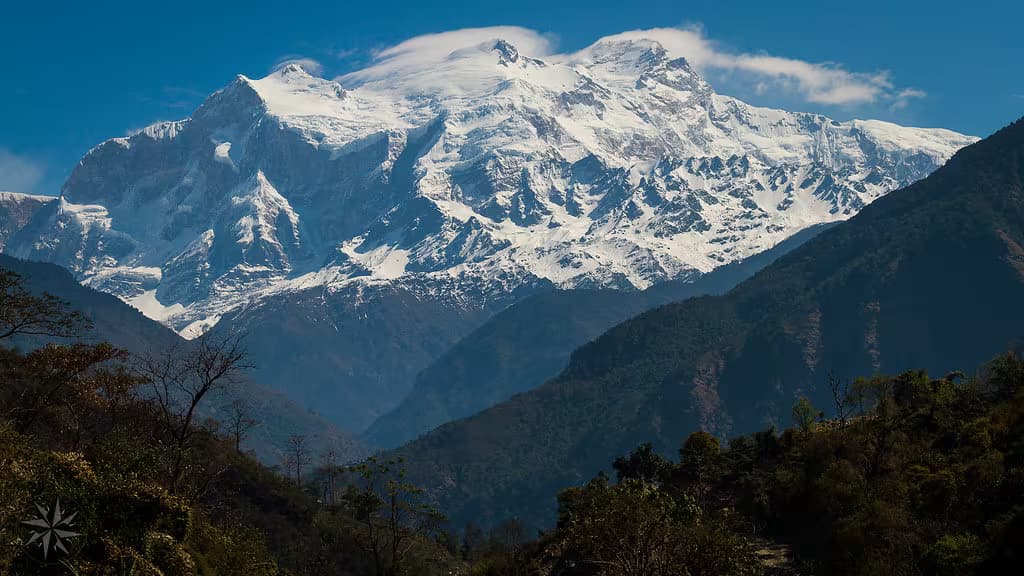
The sacred twin-peaked mountain on Nepal's time meridian — Gauri (the goddess) and Shankar (Shiva) united in stone at 7,134m.
Mountain Weather
Gaurishankar (7,134m) is one of the most culturally and historically significant mountains in Nepal. Its two summits — Gauri (the northern, lower peak) and Shankar (the southern, higher peak) — represent the divine union of the goddess Parvati (Gauri) and Lord Shiva (Shankar) in Hindu cosmology. The mountain straddles the border between Dolakha District and Tibet in the Rolwaling Himal, approximately 100 km east-northeast of Kathmandu.
Gaurishankar holds a unique place in Nepal's national identity: Nepal Standard Time (UTC+5:45) is set to the Gaurishankar meridian at 86°15' E, making it the temporal anchor of the entire country. The mountain was long considered so sacred that climbing was forbidden until 1979, when an American-Nepali expedition led by Al Read received special permission. On May 8, 1979, John Roskelley and Dorje Sherpa reached the summit via the west face — a landmark ascent in Himalayan climbing history, both for its technical difficulty (TD grade) and its cultural significance. Roskelley famously pledged to the local community that he would leave the summit untouched, taking only photographs.
The Rolwaling Valley approach to Gaurishankar Base Camp is one of Nepal's most pristine trekking experiences — a 12-14 day journey through the homeland of the Rolwaling Sherpas, a small and culturally distinct community. The valley, known as the 'Graveyard of the Yeti' in local legend, is flanked by Gaurishankar to the west and Melungtse (7,181m) to the east across the Tibetan border. Tso Rolpa, one of the largest glacial lakes in Nepal at 4,580m, is a highlight of the approach. Best seasons: spring (April-May) and autumn (October-November).
Location
Planning this climb? Local operators publishing trips here can arrange it.
Elsewhere in this region
Help us get it right
Know Gaurishankar better than we do?
We write from research and reporting, and the ground changes faster than we can keep up. If something here is out of date, or you have been and would tell it differently, we would rather hear it.