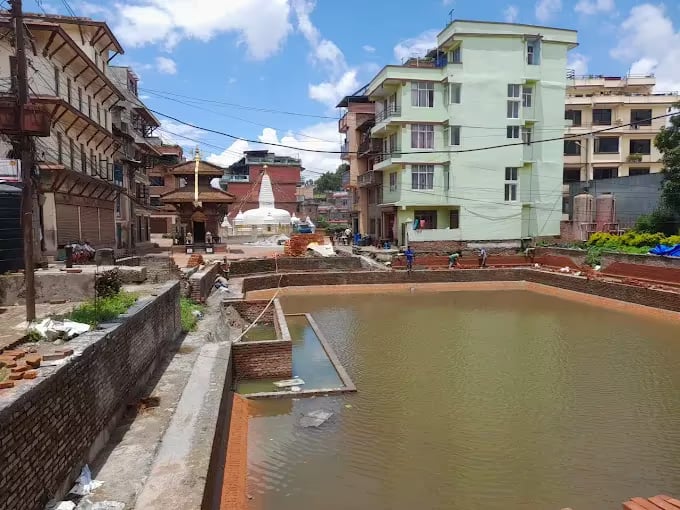
Guita Pukhu
Patan's most ancient surviving pond, built by King Sarvananda — a downstream reservoir that exemplifies the Newar water-urbanism principle of cascading ponds protecting settlements from stormwater surges.
- Altitude
- 1,330 m
- Coordinates
- 27.666°, 85.324°
Current Weather
Guita Pukhu holds a special place in Patan's water heritage as the city's oldest surviving pond, built by King Sarvananda of the Licchavi or early medieval period. The pond is classified as a downstream reservoir in the traditional Newar water management system — positioned at the lower end of the settlement to receive stormwater runoff, grey water from stone spouts, and surface drainage, thereby protecting the city core from flooding during the monsoon and preventing slope scouring and landslides at the settlement's edge.
Unlike upstream ponds that were fed by rajkulo canals and artisan wells, downstream ponds like Guita were designed to fluctuate seasonally — filling to capacity during the monsoon and often drying out partially or entirely during the dry months. This seasonal rhythm was an intentional feature of the system, allowing the pond's clay bed and its ecosystem of flora and fauna to naturally process and recycle nutrients. During dry periods, local communities traditionally used the exposed bed for community gatherings and seasonal activities.
The pond is located in the southern part of Patan, away from the heavily visited Durbar Square circuit. It retains its traditional rectangular shape, though urban growth has reduced its surroundings. Guita Pukhu is less manicured than the better-known Patan ponds — its appeal lies in its authenticity as a working piece of medieval hydraulic infrastructure that still functions largely as designed. It is best visited during or just after the monsoon when the pond is full, and combines well with a walk through Patan's southern traditional neighbourhoods. No entry fee is charged.
Location & What's Inside
Planning this trip? Local operators publishing trips here can arrange it.
Elsewhere in this region

Help us get it right
Know Guita Pukhu better than we do?
We write from research and reporting, and the ground changes faster than we can keep up. If something here is out of date, or you have been and would tell it differently, we would rather hear it.