Saptapatal Pokhari
Patan's great lost pond, brought back — a Licchavi-era reservoir at Lagankhel that shrank to almost nothing under fifty years of encroachment and reopened in August 2026 after a fifteen-year court battle.
- Altitude
- 1,330 m
- Coordinates
- 27.664°, 85.322°
Current Weather
Saptapatal Pokhari sits beside the Lagan Thur stupa — the largest of Patan's four Ashoka stupas — a few minutes' walk south of Lagankhel bus park. It is described in local histories as a Licchavi-period pond, laid out when Patan was first taking urban shape, and it was one of the anchors of the valley's traditional water system: a large open reservoir at the low, southern end of the city, fed by a rajkulo canal running down from Tika Bhairav in Lele, holding monsoon water, recharging the shallow aquifer that the surrounding hitis and wells drew from.
The name is Sanskrit — sapta patal, the seven netherworlds — and the pond's ritual role explains it. An inscription at the site records the belief: when the chariot processions of Machhindranath and Minanath end, priests of the Minanath temple perform a tantric mangsahuti fire offering at the Batuk Bhairav shrine in Lagankhel — Matikwa Bhailah in Nepal Bhasa, and word that the year's jatra has concluded is then sent to all three worlds. A pair of sparrows is released into the sky to carry the news to Indralok; a pair of fish is released into Saptapatal Pokhari to carry it down to Patal-lok. The pond is the door to the underworld — which is what its name says.
The same inscription sets out the practical case alongside the religious one: this pond recharged the water in Patan's historic dhunge dharas and in the wells of the settlements in the lower part of the city.
What makes it worth a detour today, though, is the story of how it came back.
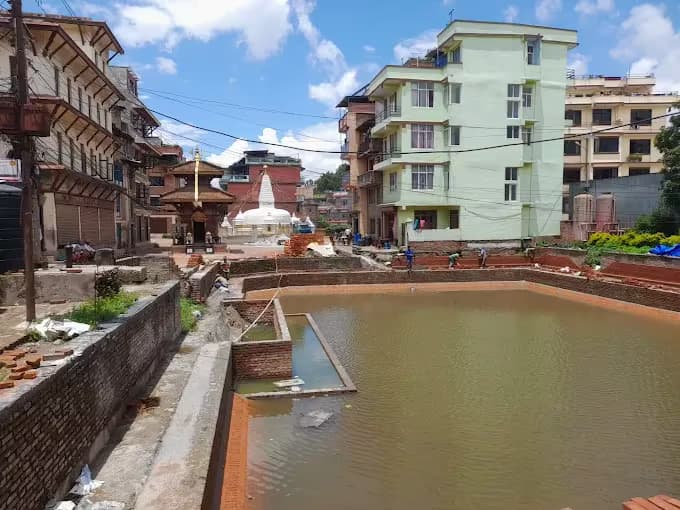
By the twentieth century the pond had been reduced to a fraction of itself. Sources put its original extent at around 200 ropanis; by the 2000s under two ropanis of open water survived, the rest built over. Two encroachers held most of it: a school, whose land registration in the late 1970s had folded in part of the pond, and an army battalion, whose compound wall enclosed a larger share still. In 2004 the residents of Lagankhel, organised as the Lagankhel Vatavaran Sudhar Sanstha under its chairman Purna Sthapit, took the matter to the Supreme Court. The case ran fifteen years — Sthapit is reported to have engaged some ten lawyers and attended roughly a hundred hearings — before the court ruled in 2019 that the land was the pond's. The army returned about 32 ropanis; the school's holding of roughly 14 ropanis followed.
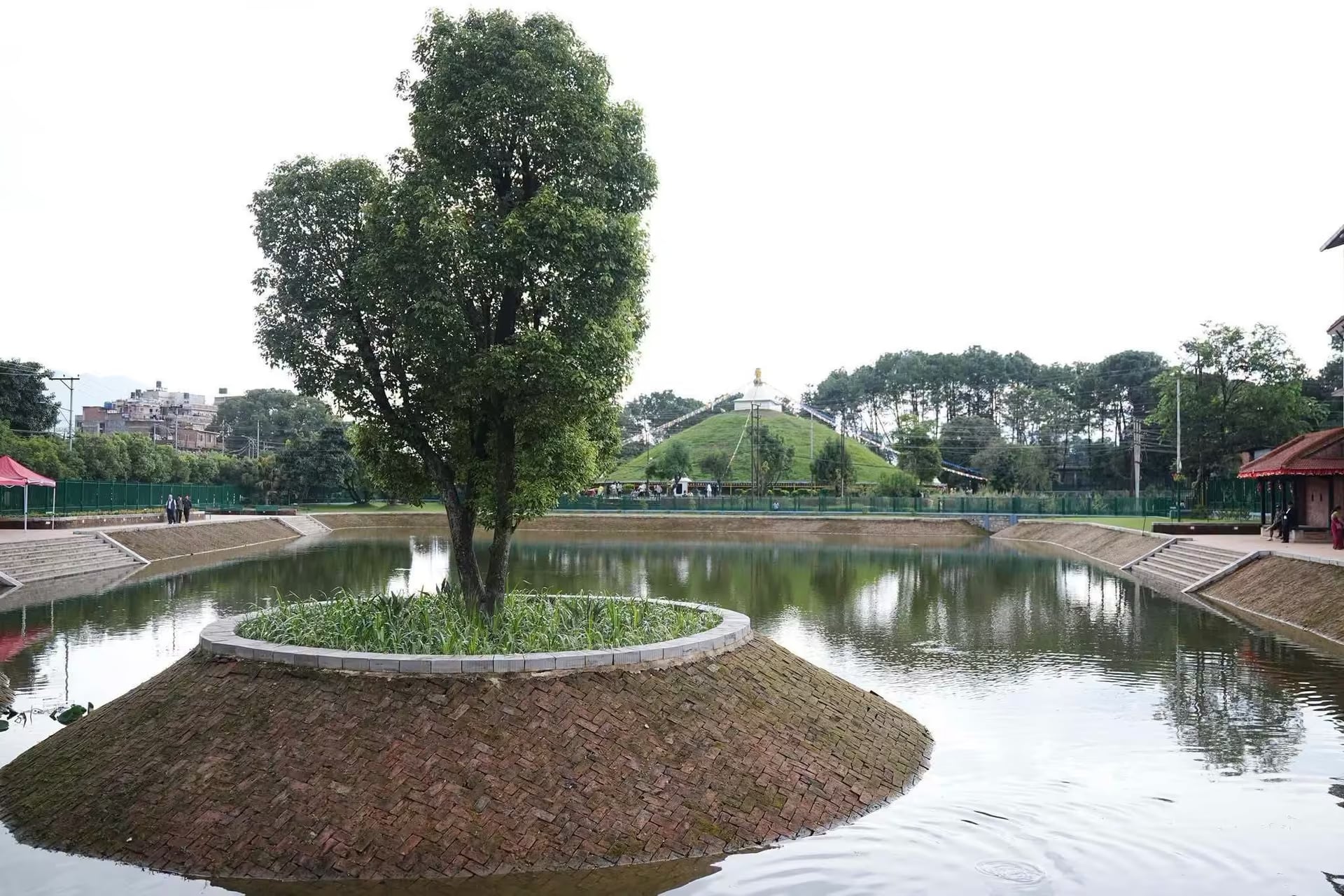
Lalitpur Metropolitan City then rebuilt it under mayor Chiribabu Maharjan, on an area of more than 45 ropanis and at a cost the site inscription puts at NPR 47.2 million, together with work on reviving the Tika Bhairav rajkulo that once fed it. The restored pond was formally inaugurated in mid-August 2026. It is the single largest heritage-pond restoration the Kathmandu Valley has seen, and a rare case of a valley water body recovered from encroachment rather than lost to it.
Paleswan Pukhu, the lotus-covered pond immediately south, was secured in the same effort — kept in public hands by agreement with the army — so the two now sit together as one restored water landscape.
Come for the scale of the open water, an increasingly rare thing in this part of the city: a brick-revetted pond with a planted island at its centre, the white dome of Lagan Thur rising directly behind it. Combine it with Guita Pukhu a few minutes northeast and Patan Durbar Square about fifteen minutes' walk north for a southern-Patan water and heritage route. Entry is free. Being newly restored, the planting and the surrounds are still young — expect a civic space rather than a weathered medieval one.
Location & What's Inside
Planning this trip? Local operators publishing trips here can arrange it.
Elsewhere in this region

Help us get it right
Know Saptapatal Pokhari better than we do?
We write from research and reporting, and the ground changes faster than we can keep up. If something here is out of date, or you have been and would tell it differently, we would rather hear it.