Sundhara
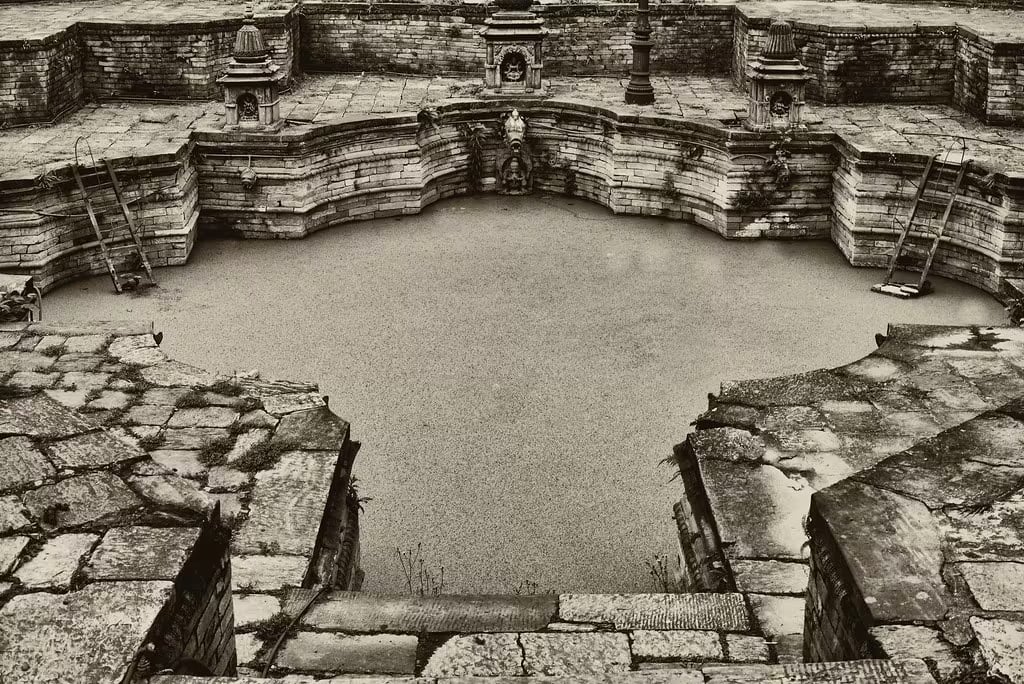
The 'golden spout' beside Dharahara — the last monumental addition to the Kathmandu Valley's 1,400-year-old stone-spout tradition, its 1820s court built by Bhimsen Thapa yet rooted in Licchavi and Malla waterworks.
- Altitude
- 1,300 m
- Coordinates
- 27.701°, 85.312°
Current Weather
Sundhara — the golden water spout (Newar Lu-hiti, from lu, gold, and hiti, a water conduit) — is a sunken stone waterworks in central Kathmandu. The elegant stepped court you see today was built in the late 1820s (commonly dated 1828–1829) by Mukhtiyar Bhimsen Thapa in honour of Queen Lalit Tripura Sundari, alongside the second Dharahara tower that gives the district its name. But that nineteenth-century construction is only the final chapter of a far older story: Sundhara belongs to the tradition of the dhunge dhara, one of the valley's oldest surviving technologies.
Stone water spouts first appeared here in the Licchavi period, more than 1,400 years ago — Patan's Manga Hiti (570 CE) is the oldest still flowing — and the network was hugely expanded under the Malla kings between the 13th and 18th centuries. Rulers such as Pratap Malla of Kathmandu (r. 1641–1674) cut long royal canals known as Rajkulo to feed the valley's ponds and spouts, and Sundhara drew on exactly this system, its water carried down from the springs of Budhanilkantha. Gold-gilded spouts like this one were a royal form, usually set within palace precincts; Sundhara centres on a gilded spout flanked by five stone spouts in a sunken court, each crowned with a small goddess shrine. It is often described as the last great monumental spout built in that ancient lineage — the tradition's grand finale rather than its origin.
Sundhara gave its name to one of Kathmandu's best-known quarters, yet the spout itself has fallen into neglect. Heritage advocates note that its water inlet was cut off when the Kathmandu Mall was built over part of the site in 2004, and the spouts have since run dry; restoration in traditional style has been repeatedly proposed. It makes an easy, poignant stop on any walk taking in Dharahara and the Sundhara–New Road quarter.
Location
Trips that visit here
Elsewhere in this region
Help us get it right
Know Sundhara better than we do?
We write from research and reporting, and the ground changes faster than we can keep up. If something here is out of date, or you have been and would tell it differently, we would rather hear it.