Stupa · Syncretic
Swayambhunath
स्वयम्भूनाथ❊सिंगु
Adi-Buddha / Harati Devi·5th century CE (legendary origins ~2000 years)·Kathmandu·UNESCO World Heritage
Self-arisen hilltop stupa older than the city below it, where Buddhist and Hindu worship share one summit — and the month of Gunla fills the steps with dawn music.
Dedicated to
Adi-Buddha / Harati Devi
Period
5th century CE (legendary origins ~2000 years)
Hours
Open 24 hours
Admission
Local 200 · USD 2
Neighborhood
Swayambhu
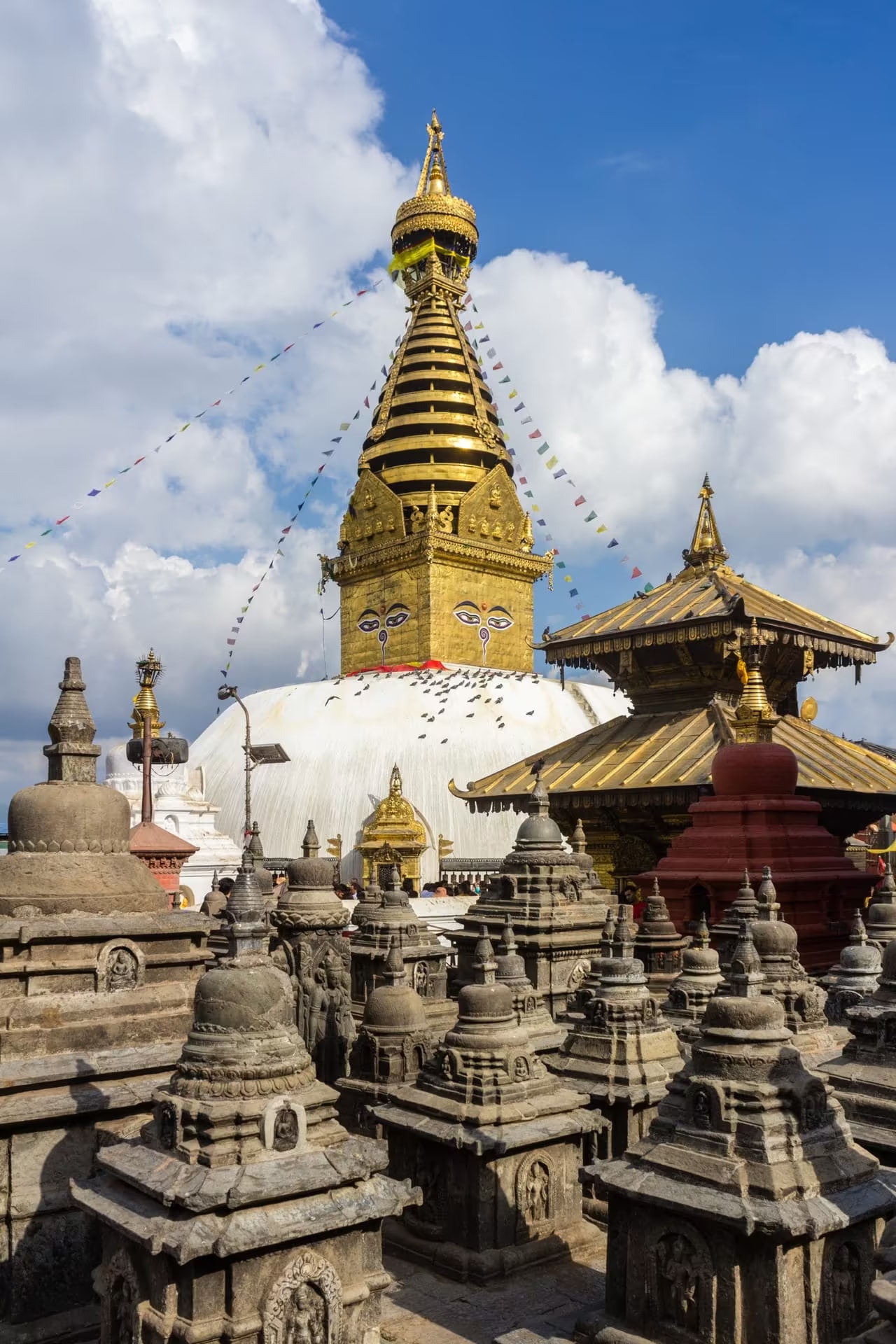
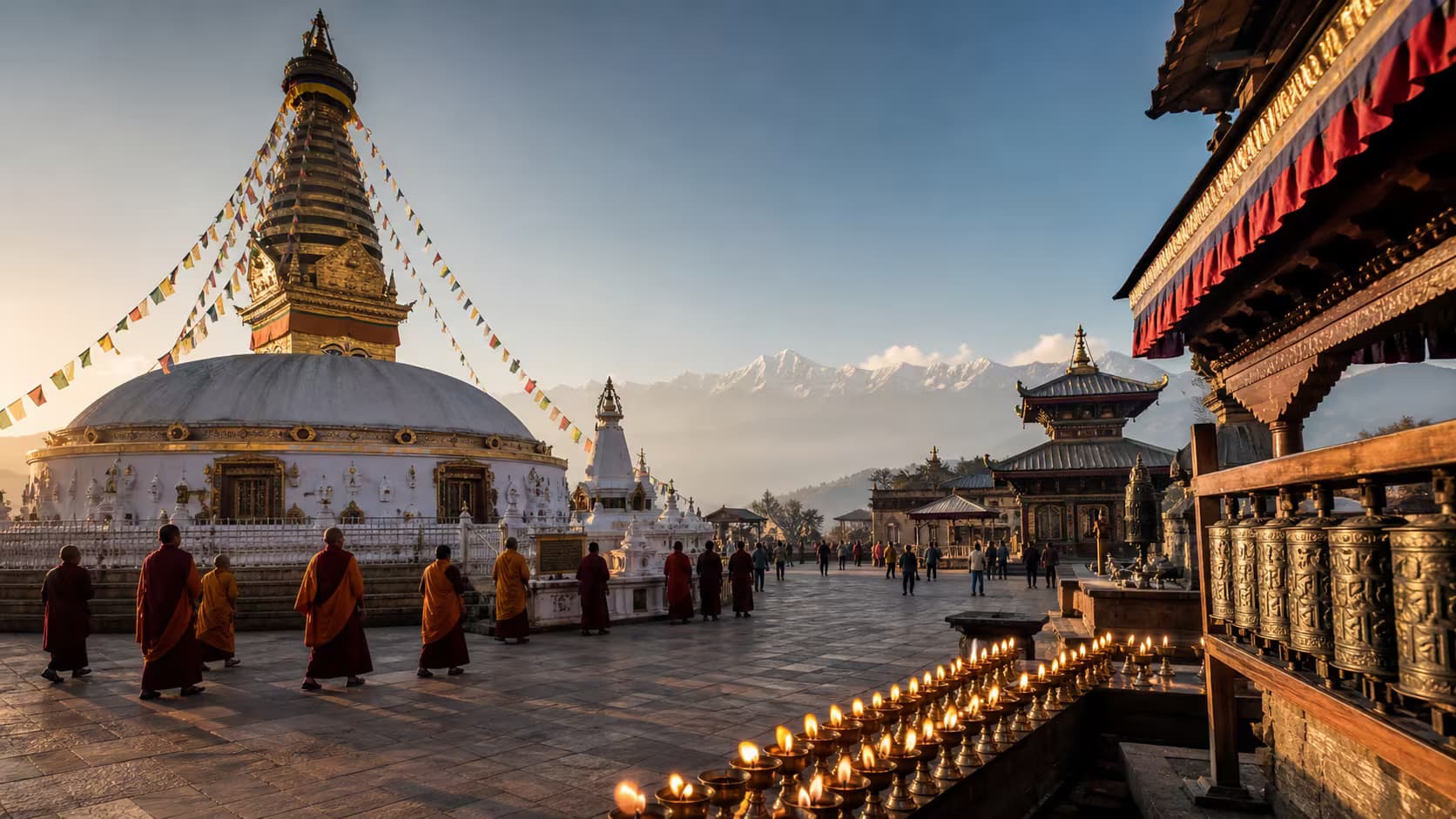
Swayambhunath rises on a conical, monkey-busy hill west of Kathmandu, its gilded spire and painted eyes visible from across the Valley. This is one of the oldest sacred places in Nepal — by tradition older than the city itself — and one of the most layered: a great Buddhist stupa ringed by Hindu shrines, tantric temples, and chaityas, where the Valley's two religions have shared a single summit for as long as anyone has written things down.
The lotus of the lake
The Swayambhu Purana tells how the Kathmandu Valley was once a vast lake, in whose centre bloomed a lotus carrying a self-arisen (swayambhu) flame of primordial Buddha-light. The bodhisattva Manjushri, coming from the north to worship it, cut the gorge at Chobhar with his sword and drained the lake so that people could live here and honour the light — and the lotus settled as this very hill. Newar tradition completes the geography: the root of that lotus lies across the city at Guhyeshwari, so the stupa and the goddess temple are two ends of one sacred stem. Geology, pleasingly, agrees about the lake. Recorded history reaches nearly as deep — the chronicles credit Licchavi kings around the 5th century with the first great works here, and the stupa was already ancient when the 1349 invasion sacked it along with nearly every shrine in the Valley.
Shantipur and the king who went underground
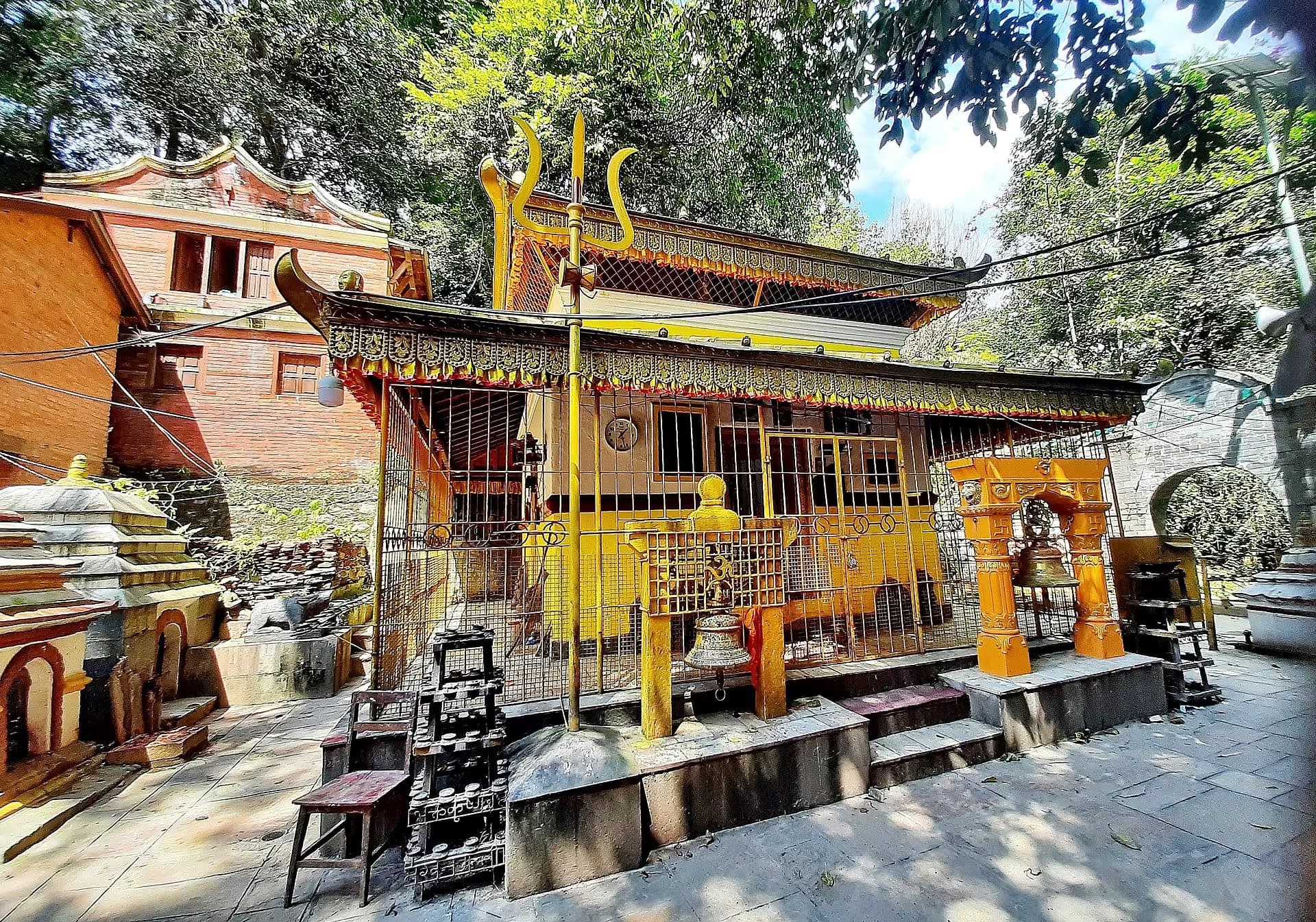
On the northern edge of the complex stands Shantipur, an unassuming plastered shrine concealing, by tradition, a sequence of underground chambers — and in the deepest of them the tantric master Shantikar Acharya, who is believed to remain there still, in meditation, holding mastery over the rains. In 1658, with the Valley dying of drought, King Pratap Malla himself descended through the chambers and returned with a rain-making mandala, and the rains are said to have come before he reached his palace. Pratap Malla's devotion shaped the hill as you climb it today: he raised the great eastern stairway of 365 stone steps — one for each day of the year — set the huge gilded vajra at its top, and built the twin white shikharas of Anantapur and Pratapur that flank the stupa, wrecked in the 2015 earthquake and since rebuilt.
One summit, two religions
The platform around the stupa is a compressed lesson in Nepali religion. Beside the dome stands the pagoda of Harati Ajima, the once child-devouring spirit converted by the Buddha into a fierce protector of children — Buddhist by story, worshipped daily by Hindu and Buddhist mothers alike, especially when a child falls ill. Day-to-day ritual life is carried by the Buddhacharyas, hereditary Newar caretaker-priests whose families — descendants, by tradition, of those who came with Shantikar Acharya — take turns by rotation keeping the stupa's worship and upkeep. Around them: Tibetan monks at the hilltop gompa, Hindu devotees at the shrines, and the monkeys that give the site its tourist nickname, working the crowd.
Gunla: the month of dawn music
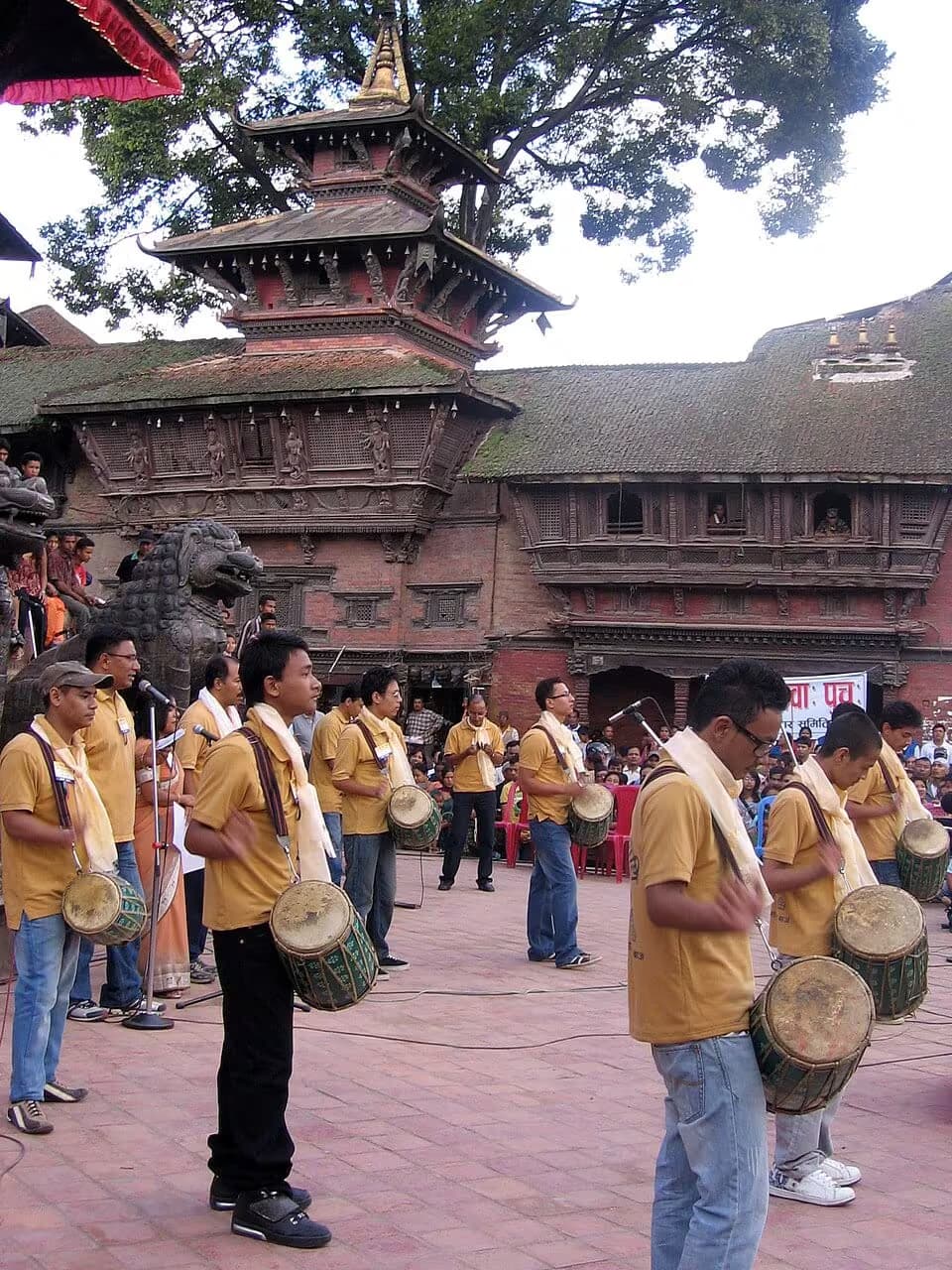
If you can choose your moment, come during Gunla — the tenth month of the Nepal Sambat calendar (roughly August), the holy month of Newar Buddhism, descended from the ancient monsoon retreat of the monks. Every morning for a month, devotional bands called Gunla Bajan set out from the old city before first light, drums and cymbals and shawms sounding through the lanes, and climb the 365 steps to the stupa as an offering of music. The hilltop at 5 a.m. during Gunla — mist, lamplight, processions arriving one after another — is among the great experiences the Valley offers, and entirely uncommercial. The rare Samyak alms-feast, when giant Dipankara Buddha images assemble below the hill, and Buddha Jayanti, when the whole complex fills for the Buddha's birthday, are the other red-letter days.
Visiting
Take the eastern stairway if your knees allow — arriving the pilgrims' way, past stone Buddhas and prayer wheels, under Pratap Malla's vajra, is half the point. A road climbs the gentler western side for everyone else. Sunset over the Valley from the platform is the classic reward. Kathmandu Durbar Square lies a half-hour's walk east through the old city, and Boudhanath across town makes the natural same-day pairing — the Valley's two great stupas, one looking down on the city, one wrapped inside it.
- Expanded during the reign of Pratap MallaAdditions 1646
Added the Anantapur and Pratapur shikhara temples and the great vajra at the eastern stairs.
Access & Mobility
The classic east approach climbs steep stone steps. A road reaches the western upper side for visitors who cannot manage the full stair climb, but the hilltop still has uneven paving and shrine steps.
- On foot
Classic pilgrim stair climb from the east side. Trail: swayambhunath-climb
- Vehicle
Road access to the upper west-side entrance reduces the climb but does not make the whole precinct step-free.
Best visited in autumn.autumn: best, 9°C to 26°C. Panoramic Kathmandu Valley views with Himalayas visible. Best light for the iconic Buddha eyes. Comfortable climbing temperature. monsoon: possible, 20°C to 29°C. Steps can be slippery. Lush green valley views between showers. Monkeys are active and bold in the rain. spring: good, 11°C to 29°C. Warm climb up the 365 steps. Haze can obscure valley views toward May. Monkey activity peaks in warmer weather. winter: good, 2°C to 19°C. Clear mountain views from the hilltop. Cold mornings but sunny by mid-morning. Spectacular sunrise if you arrive early.
The Almanac
Steps can be slippery. Lush green valley views between showers. Monkeys are active and bold in the rain.
Folio III
Nearby Sacred Sites
Places within a short walk that help turn this stop into a small sacred cluster.
Coda
Continue the Pilgrimage
Related
Connected places and entries worth pairing
Guides that feature this place
- Regional11 min
Kathmandu Valley Heritage Walk: Temples, Stupas & Living Culture
A routed three-day walk through the Kathmandu Valley's seven UNESCO monument zones — with the entry fees, opening hours and the lanes, bahals and bazaar streets that connect them.
- Regional8 min
Buddhist Pilgrimage in Nepal: Lumbini, Boudhanath, Swayambhunath & Monasteries
A Buddhist pilgrimage guide to Nepal covering Lumbini, Boudhanath, Swayambhunath, Namo Buddha, Tilaurakot, Tibetan monasteries, Newar bahals, etiquette, and festival timing.
Trips that visit here
Elsewhere in this region
Help us get it right
Know Swayambhunath better than we do?
We write from research and reporting, and the ground changes faster than we can keep up. If something here is out of date, or you have been and would tell it differently, we would rather hear it.