Hadigaun Jatra (Chokte Narayan Jatra)
हाँडीगाउँ जात्रा (चोकदे नारायण जात्रा)
Also known as: Hadigaun Jatra, Handigaun Jatra, Handigaon Jatra, Chokte Narayan Jatra, Chokhte Narayan Jatra, Chokde Narayan Jatra, Chokkathunarayan Jatra, Chokket Narayan Jatra, Tin Narayan Jatra, Kahi Nabhayeko Jatra, Kahi Nabhako Jatra, हाँडीगाउँ जात्रा, चोकदे नारायण जात्रा, कहीँ नभएको जात्रा
Hadigaun's Narayan festival at the close of Dashain: three shoulder-borne khats with inverted spires, turning through the neighbourhood beneath offerings of wax flowers. This is the jatra behind the saying 'Kahi Nabhayeko Jatra Hadigaun Ma' — a festival like nowhere else.
Location
Hadigaun (Handigaun), Kathmandu
Duration
3 days
Month (Local)
Ashwin/Kartik
Month (AD)
October
Coming up next
This year's celebration has passed.
Highlights
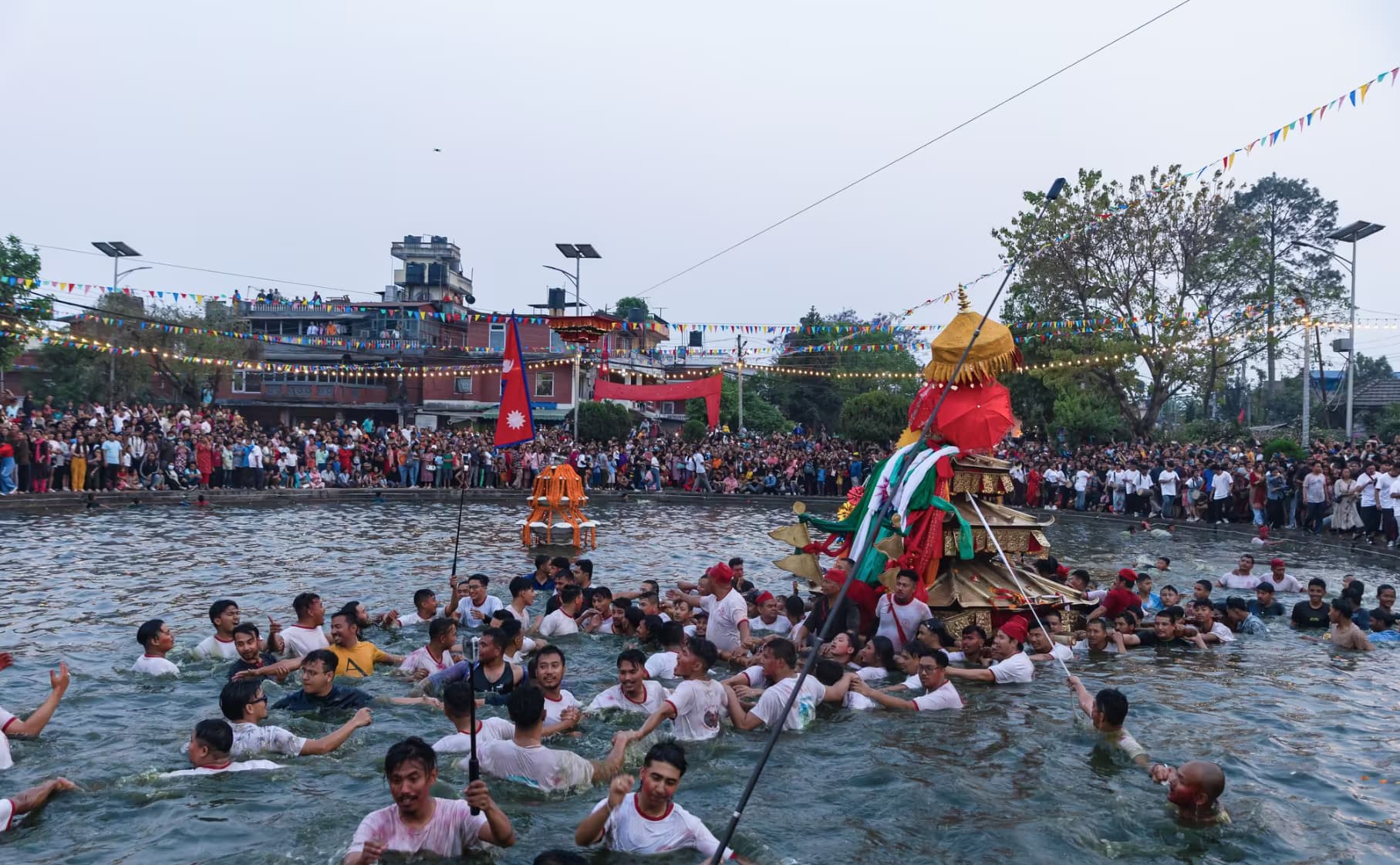
Three shoulder-borne, wheel-less khats with the gajur below and the deity above. Khats turned as they move through Hadigaun's streets. Wax flowers offered to Narayan and decorating the procession. Neighbourhood worship and devotional music after Kojagrat Purnima. The living tradition behind 'Kahi Nabhayeko Jatra Hadigaun Ma'.
Tips for Visitors
Plan around the day after Kojagrat Purnima, then confirm the annual date, assembly time and route with Hadigaun's local organisers. The formal opening is on the full-moon day; the following three days are not a continuous procession. Leave room for the khat bearers and rotating structures, keep entrances clear, and ask before photographing worshippers closely. Do not reach into moving khats to collect wax flowers. This is the autumn Narayan jatra, not Gahana Khojne Jatra at Gahana Pokhari.
When Dashain reaches its closing full moon, Hadigaun has another procession to prepare for. Hadigaun Jatra, also known as Chokte Narayan Jatra, honours Narayan, or Vishnu, in the old Newar neighbourhood of northeastern Kathmandu. Its three unusual khats — carried on shoulders rather than pulled on wheels — give physical form to the familiar saying Kahi Nabhayeko Jatra Hadigaun Ma: a festival found nowhere else takes place in Hadigaun.
The name appears in several spellings. Community heritage organisation Baakhan Nyane Waa uses Chokhte Narayan; Kathmandu Metropolitan City's account calls it Chokde Narayan (चोकदे नारायण); news reports also use Chokkathunarayan and Tin Narayan, the names under which the festival's guthi land is recorded. These names refer to this Narayan procession, not to every festival held in Hadigaun.
When to come
The festival belongs to the end of Dashain, around Kojagrat Purnima, usually in October. Kathmandu Metropolitan City's account distinguishes the formal opening, when the image is brought out on the full-moon day, from the three days of jatra observances beginning the following day. Reporting on the street procession commonly describes that following day as the start of the festival.
For planning, the day after Kojagrat Purnima is the key reference point, not Vijaya Dashami, the earlier tika day. The Gregorian date moves each year. Confirm the year's procession date, assembly time and route with the local organisers before arranging a visit; the three-day observance does not mean the khats are continuously on the move. An exact date should come from the year's local calendar and announcement, not from adding a year to the previous celebration.
Three khats, upside-down spires
The distinctive sight is a group of three wheel-less khats, wooden and bamboo structures carried through the neighbourhood by teams of devotees. Their arrangement reverses the familiar temple silhouette: the gajur, or spire, sits below, while the deity is placed above. The broad upper structure has the appearance of an inverted umbrella.
As the bearers carry each khat through the streets, an attendant at its base turns the structure. The procession combines this rotating movement with devotional music, worship and offerings along the way. Accounts commonly associate the three khats with Brahma, Vishnu and Maheshwar, although local tellings also interpret them through the family in the festival's origin legend. Reporting on the 2026 procession has each khat setting out from its own part of the neighbourhood: Brahma from upper Thatal, Vishnu from middle Nyalma and Maheshwar from lower Kotal.
The event belongs to Hadigaun's neighbourhood community, not to Kathmandu Durbar Square. Reporting describes the procession moving through Hadigaun, Bishalnagar and the Gahana Pokhari area. Use these as orientation points, rather than treating them as a fixed turn-by-turn itinerary for every year.
Flowers made of wax
Wax flowers are another defining feature. Made for the festival and offered to Narayan, they decorate the khats rather than simply standing in for ordinary flowers. As the structures turn, devotees collect flowers that fall. The craft and the stories attached to it are part of Hadigaun's living heritage: local storytelling sessions have been devoted specifically to the jatra and its wax flowers.
The promise behind the procession
One widely told origin story concerns two pregnant sisters. One places her trust in Narayan; the other dismisses the need for divine help and later struggles to give birth. Relief comes after a promise to honour the deity with a festival unlike any other, and with extraordinary flowers. The unusual khats and wax offerings fulfil that promise each year.
This is an origin legend, not a documented medical or historical account. Versions differ on the length of the pregnancy and on how Narayan is persuaded to return. Accounts also differ on the festival's antiquity: Kathmandu Metropolitan City's account places the Narayan jatra in the Lichhavi era, while reporting cites a Newar-language inscription on the temple door crediting its start to the reign of King Narendra Malla. Hadigaun's ancient settlement history should not be mistaken for a securely dated founding of this particular procession.
Visiting respectfully
Come for a neighbourhood religious celebration, not a scheduled stage show. Ask locally where the khats will assemble and watch from a place that leaves their route clear. Give the bearers and turning structures plenty of room, keep doorways and shrine approaches open, and follow directions from organisers when the procession moves.
Ask before taking close portraits or photographing worship at a household's threshold. Do not reach into a moving khat for a flower or souvenir. Comfortable shoes and a light bag are more useful than a tripod in crowded lanes; agree on a meeting point if visiting with children or a group.
Do not confuse this autumn Narayan jatra with Gahana Khojne Jatra, the separate Tudaldevi festival associated with searching for ornaments in Gahana Pokhari. They share a neighbourhood, not a ritual or a calendar date.
Sources and further reading
- Kathmandu Metropolitan City: Chokde Narayan Jatra in Hadigaun — Nepali-language account of the name, opening rites, three-day observance and origin legend.
- Baakhan Nyane Waa: Chokhte Narayan Jatra and the wax flower — community storytelling programme with a Hadigaun cultural organiser; its May event date is not the jatra date.
- The Kathmandu Post: Handigaun Jatra, a jatra like no other — reporting on the 2026 procession, khats and wax flowers.
- The Rising Nepal: Hadigaun celebrates Narayan Jatra — the shoulder-borne khats, neighbourhood procession and community tradition.
Elsewhere in this region
Help us get it right
Know Hadigaun Jatra (Chokte Narayan Jatra) better than we do?
We write from research and reporting, and the ground changes faster than we can keep up. If something here is out of date, or you have been and would tell it differently, we would rather hear it.