Dashain (Vijaya Dashami)
दशैं
Also known as: Vijaya Dashami, Bada Dashain, Navaratri
Nepal's longest and most auspicious festival spanning 15 days, celebrating the victory of goddess Durga over the demon Mahishasur.
Location
Nationwide
Duration
15 days
Month (Local)
Ashwin
Month (AD)
October
Plan around Dashain (Vijaya Dashami)Dashain: Fulpati to Vijaya Dashami — 4 DaysShow planHide plan
Dashain: Fulpati to Vijaya Dashami — 4 Days
Dashain runs fifteen days and most of it happens inside family homes. This plan covers the four you can actually attend — Fulpati to Vijaya Dashami.
4 days · 10 stops
Copying makes it yours — change any day, then share the link with whoever you're going with.
Highlights
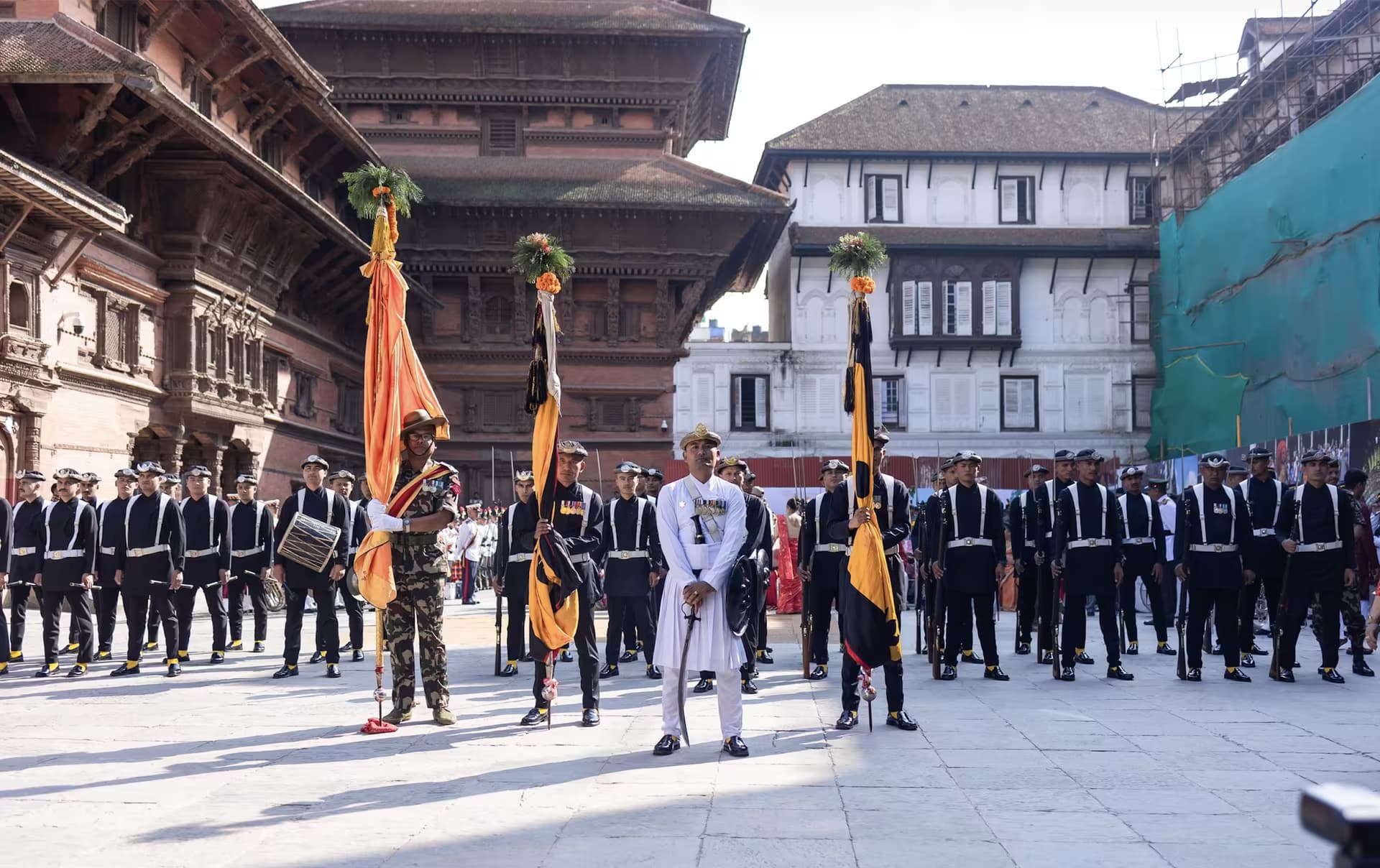
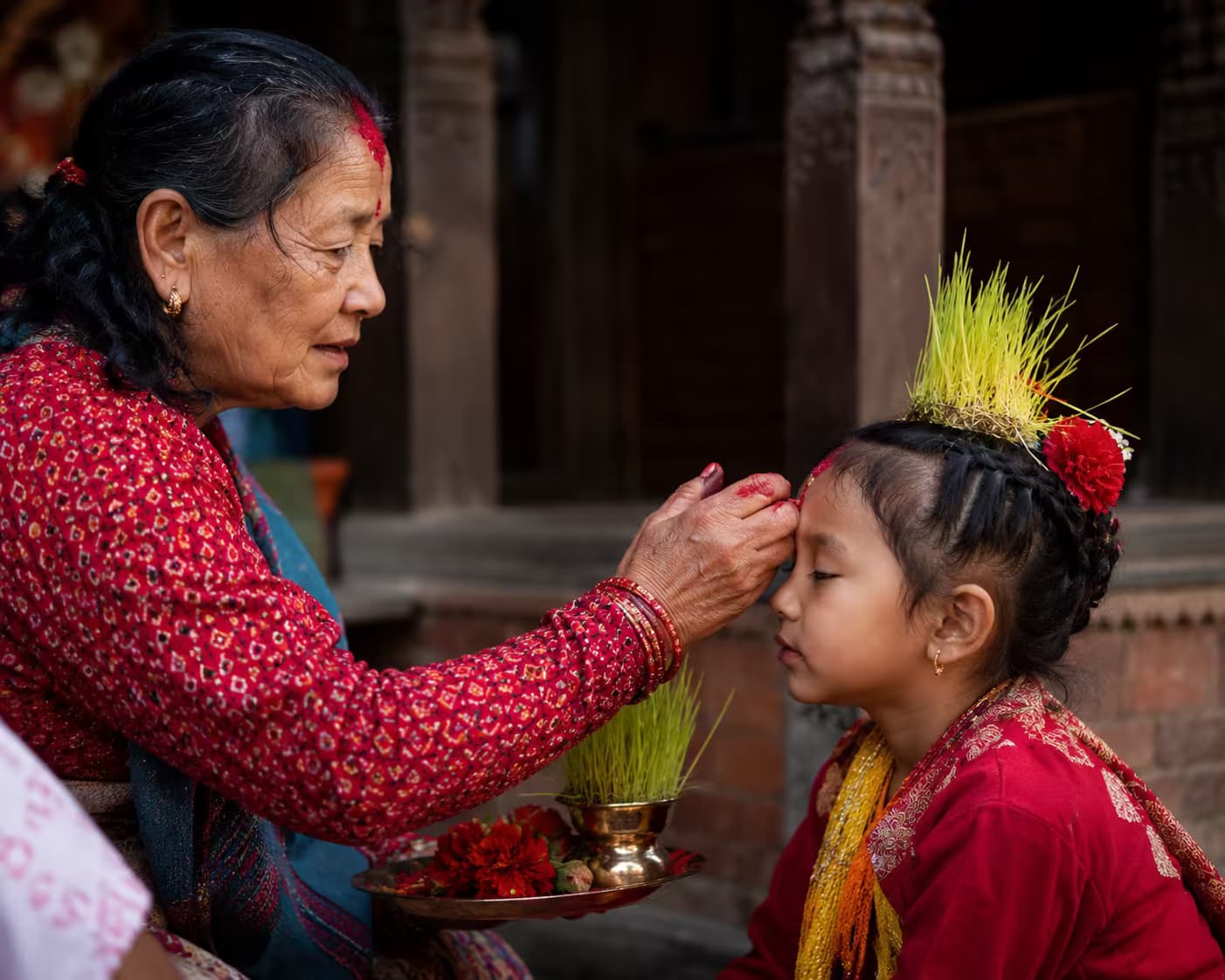
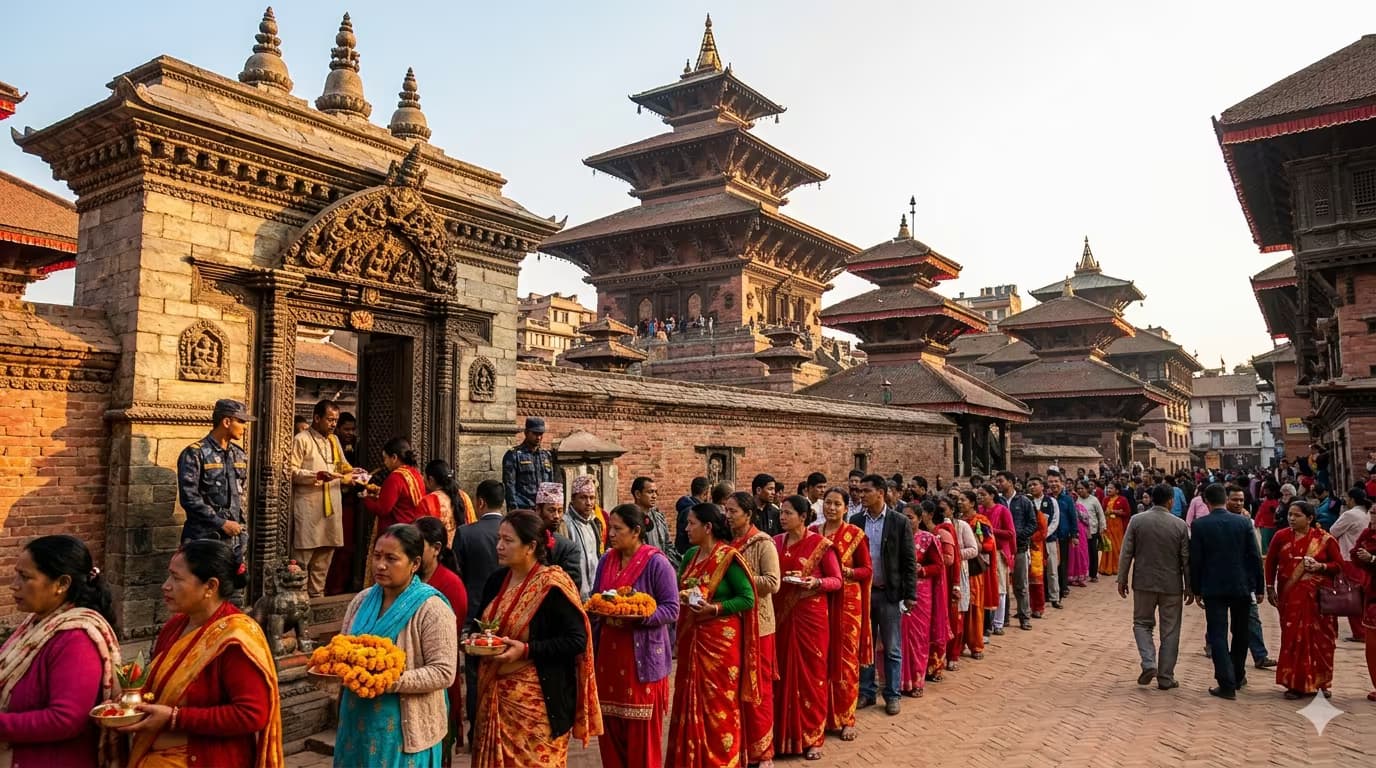
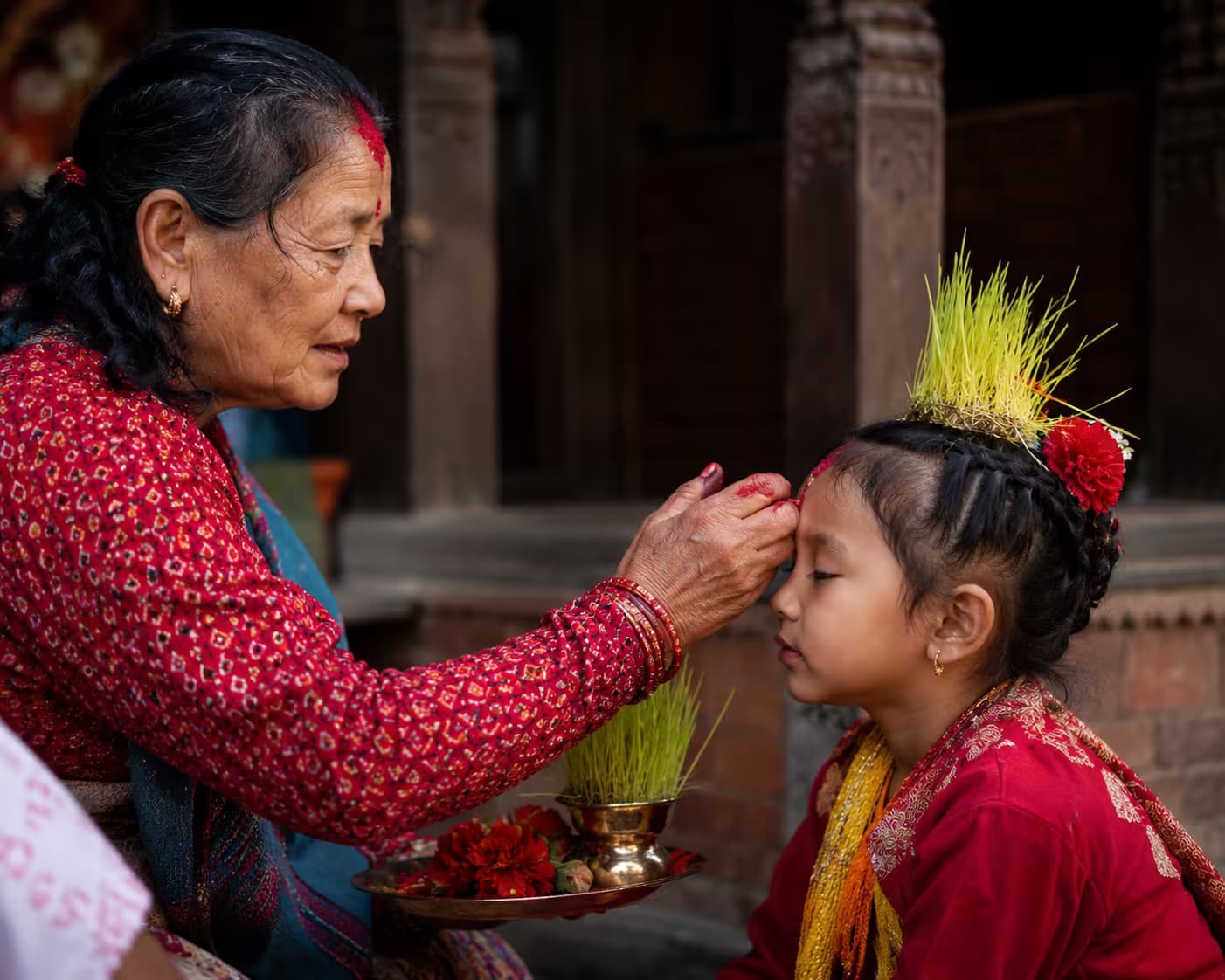
Tika and jamara on Vijaya Dashami — elders bless the younger generation, and the blessing can only be given in person. The Fulpati procession carrying Gorkha's sacred bouquet into Kathmandu. Taleju's temple open to the public for one night a year. Bamboo ping swings in the hill villages. Kites over the clearest sky of the year. Mohani, the Newar fortnight running alongside the national one with its own calendar and its own goddess.
Tips for Visitors
Most businesses, restaurants and government offices close during Dashain — plan accordingly. Transport is the real constraint: millions are moving, and flights and buses in the days on either side of tika sell out weeks ahead. Check the [Dashain 2026 dates and schedule](/guides/dashain-2026-dates-schedule) before booking anything, because the tika day moves every year with the lunar calendar. If you would rather not see animal sacrifice, avoid temple courtyards on the eighth and ninth days; the rest of the fortnight is unaffected. If you are invited to a Nepali home for tika, it is a real honour — accept, bring nothing expensive, and let the elders go first.
Dashain is the axis the Nepali year turns on. For fifteen days in the clear light after the monsoon, the country stops: offices shut, schools break, courts adjourn, construction sites fall silent, and the buses out of Kathmandu run full for a week in one direction and full for a week in the other. It is not the most visually spectacular festival in Nepal — Indra Jatra and the chariot jatras of the Valley are louder and stranger to watch — but it is the one that organises everything else. Nepalis date the year by it. Work is scheduled around it. A great many people measure how their year went by whether they got home for it.
Going home
The single most important fact about Dashain is that it is a homecoming. The ancestral house is where tika is received, and it is received from the hands of the oldest surviving members of the family — which means that the direction of the blessing runs down a family tree that only exists in one place. Nobody can send it. So the fortnight produces the largest internal movement of people Nepal sees all year: out of Kathmandu into the hills, out of the Terai towns into the villages behind them, and — increasingly — off aeroplanes from the Gulf, Malaysia and Korea into Tribhuvan airport, for the one trip home a two-year contract allows.
The capital empties. Streets that are gridlocked in ordinary weeks become quiet enough to hear birds in. Shops close for days at a stretch, and the ones that stay open are the ones serving the people who could not leave. Anyone arriving in Kathmandu expecting a normal city during the days around tika will find something closer to a held breath — which is either the most atmospheric week of the year to be here, or an infuriating one, depending entirely on what you came to do. The Dashain 2026 dates and schedule is the page to read before booking anything, because the tika day moves with the lunar calendar and the days on either side of it are the worst of the fortnight to be travelling.
What the fortnight is for
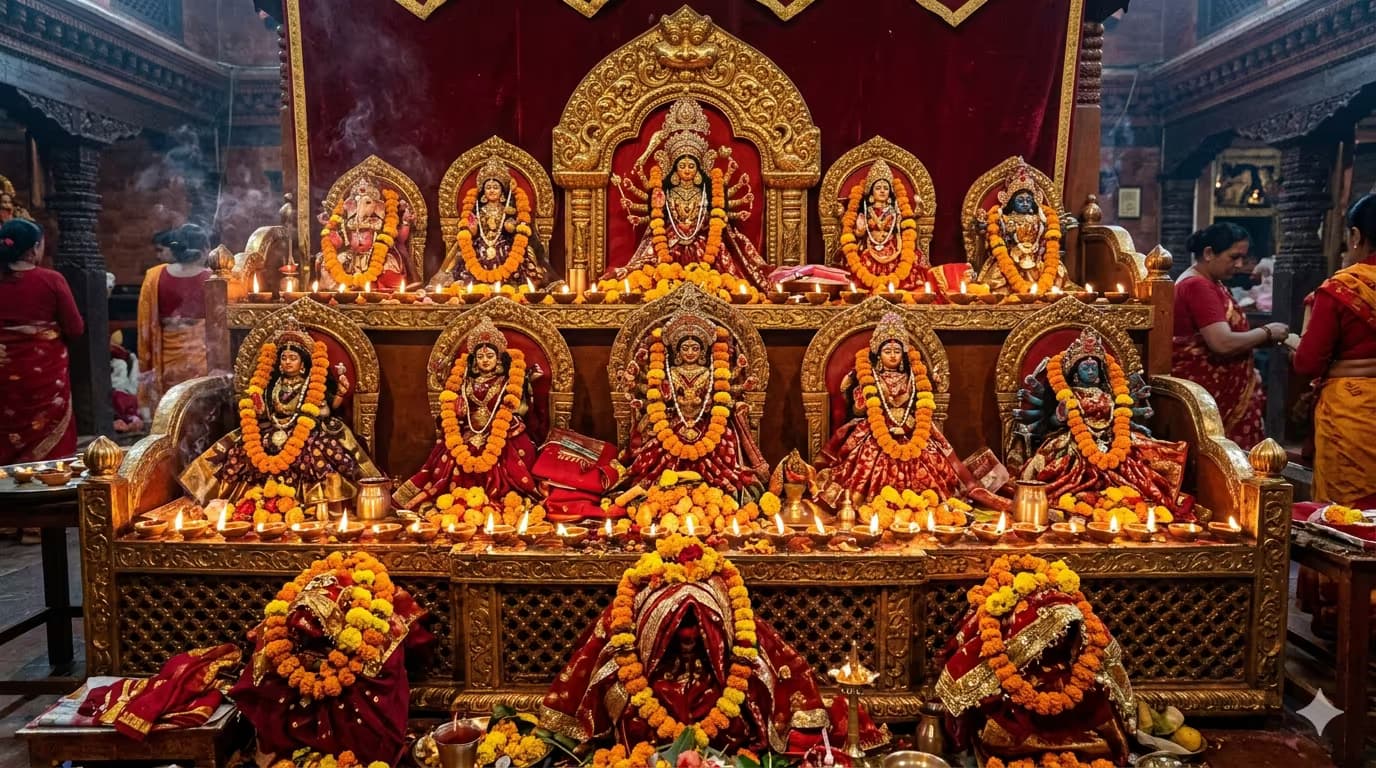
The festival marks Durga's defeat of Mahishasura, the buffalo demon no god had been able to kill. The theology is that the goddess is not one thing: she is invoked across nine nights in nine forms, from the gentle to the terrifying, and the victory belongs to the whole sequence rather than to any single night of it. That is why the fortnight has the shape it does — nine nights of accumulating intensity, culminating in a single morning of blessing.
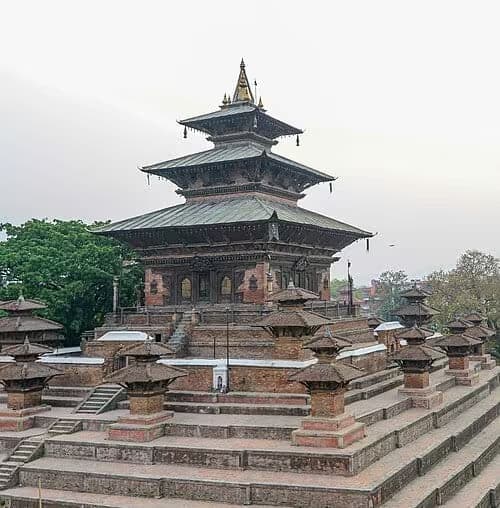
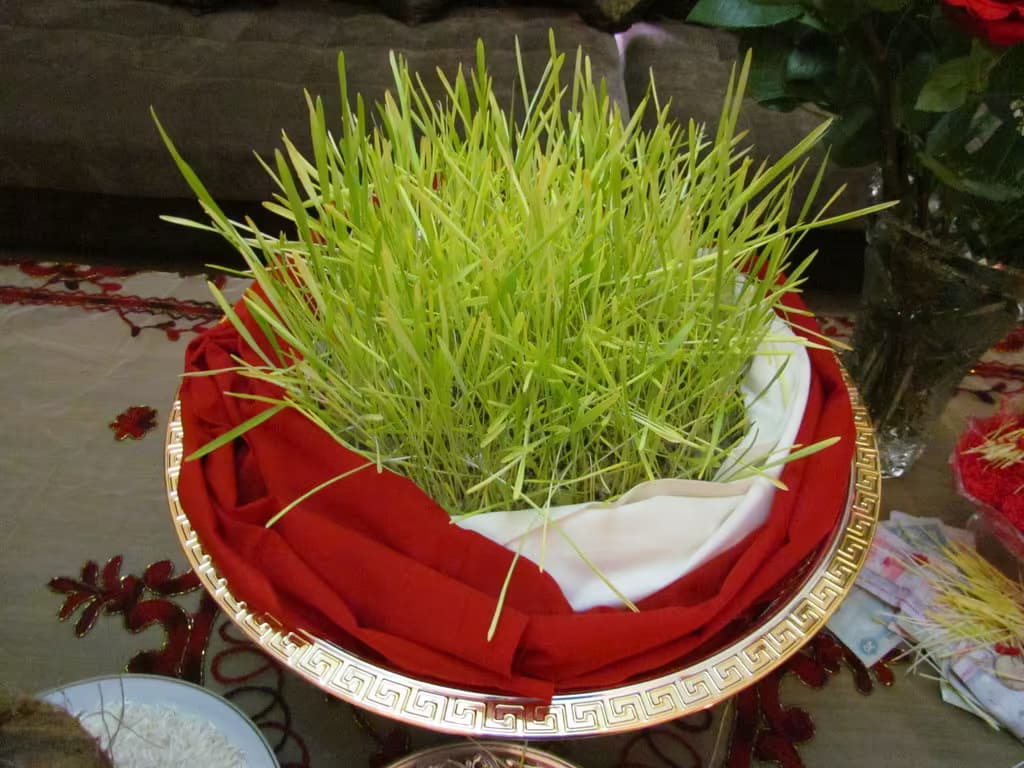
Each stage has its own logic and its own page here: the barley planted in river sand on Ghatasthapana, the sacred bouquet carried from Gorkha on Fulpati, the nine forms invoked across Navaratri, the dark night of Maha Ashtami, the consecration of tools and vehicles on Maha Navami, the one night Taleju's temple opens, the tika of Vijaya Dashami, and the full moon of Kojagrat Purnima that closes it.
Mohani: the same fortnight, a different festival
In the Newar towns of the Kathmandu Valley the fortnight is Mohni, its own name in Nepal Bhasa, and the greeting is Mohni nakhaya bhintuna. The timing and the core structure are shared with the national festival — the tika and jamara of the tenth morning are the same tika and jamara — but the emphasis is not. Vijaya Dashami is Mohni Nakha here, and it is built around the Kuchhi Bhwoye, the lineage feast: an elaborate multi-course meal following the family's own order, quite distinct from the lighter post-tika visiting elsewhere. Guthi, the communal organisations that run Newar ritual life, hold their own gatherings.
The name itself points at a different reading of the goddess. Mohni derives from Mohani, the one who enchants — a tantric Durga whose victory is as much seduction as combat, rather than the warrior of the pan-Hindu telling. The same layer runs under Taleju's one night open to the public: in Newar understanding Taleju is not a Brahminical import but a tantric goddess whose worship predates her adoption by the Malla kings, so the temple's annual opening is Hindu state ceremony and older Newar tradition converging at one threshold.
Most Newar families now hold both registers at once without finding it contradictory. But when a Kathmandu household says the festival is starting, they may mean something with a longer and more local history than their neighbour does.
Sacrifice
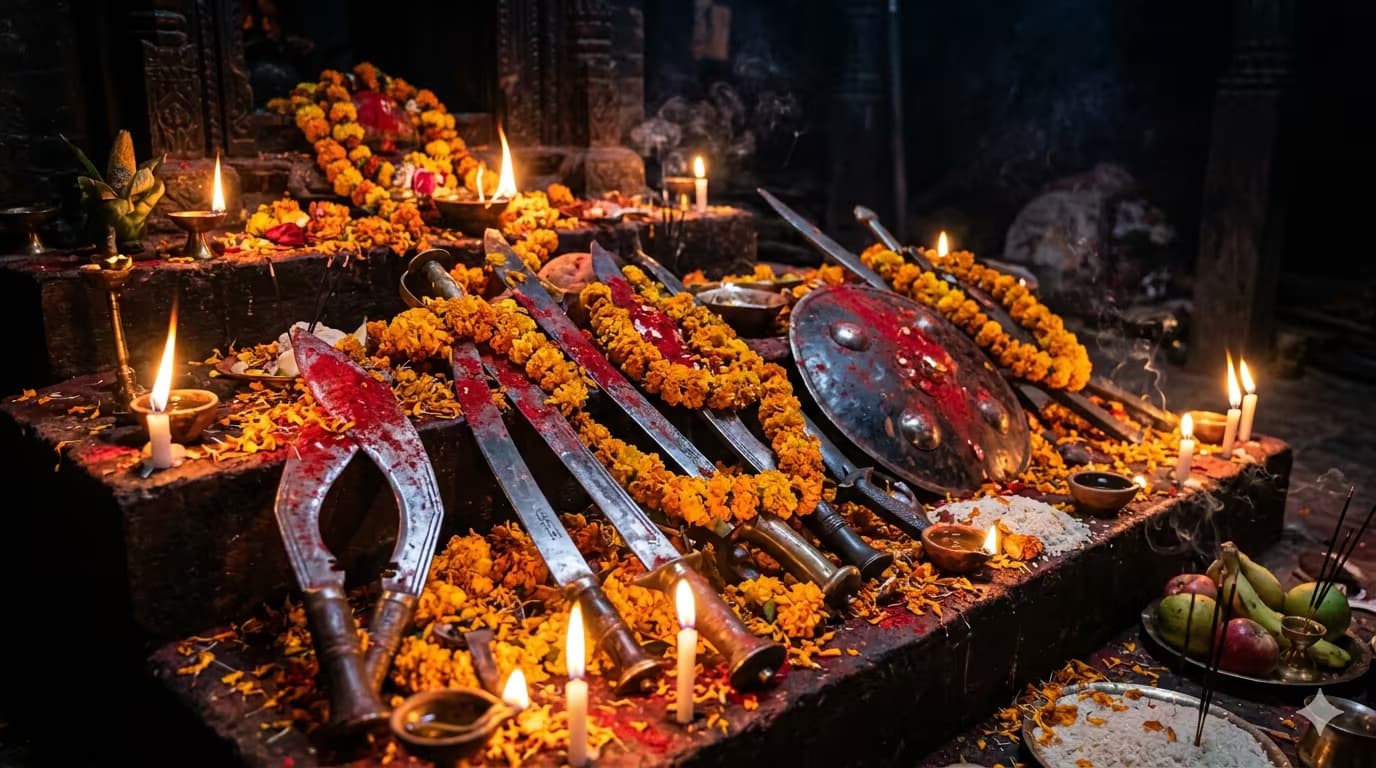
Animal sacrifice is the part of Dashain visitors ask about most, and it is usually explained to them as a warning rather than as a subject. Goats, buffalo, ducks and chickens are offered to Durga across the fortnight, concentrated on Maha Ashtami and Maha Navami. The logic is not cruelty and not, primarily, meat: the offering is a life given to a goddess who is understood to require one, and the animal is eaten afterwards by the family that gave it. For a great many Nepali households this is the one week of the year with meat on the table every day.
It is also declining, and visibly. Pumpkins, coconuts, ash gourds and sugarcane are accepted substitutes and are increasingly the norm in urban families; the Nepal Supreme Court and a run of temple committees have moved against mass sacrifice at particular sites; and a generation of younger, city-raised Nepalis is quietly not continuing it. The vehicle blessing of Maha Navami, where a bus or a motorbike is anointed and a gourd is broken in front of it rather than an animal, is the compromise made visible. Anyone who does not want to see it should stay away from temple courtyards on the eighth and ninth days — which is easy, because the rest of the festival is happening everywhere else.
Kites, swings and sel roti
Autumn in Nepal used to mean kites. The post-monsoon sky is the clearest of the year and the wind is right, and for generations the fortnight meant rooftops full of children flying against each other with glass-coated line, shouting chait! when a rival's string went. It is fading — power lines, apartment blocks, phones — and in central Kathmandu it has largely gone, but it survives in the hill towns and in the older neighbourhoods, and the sky over a Terai town in early October is still worth looking up at.
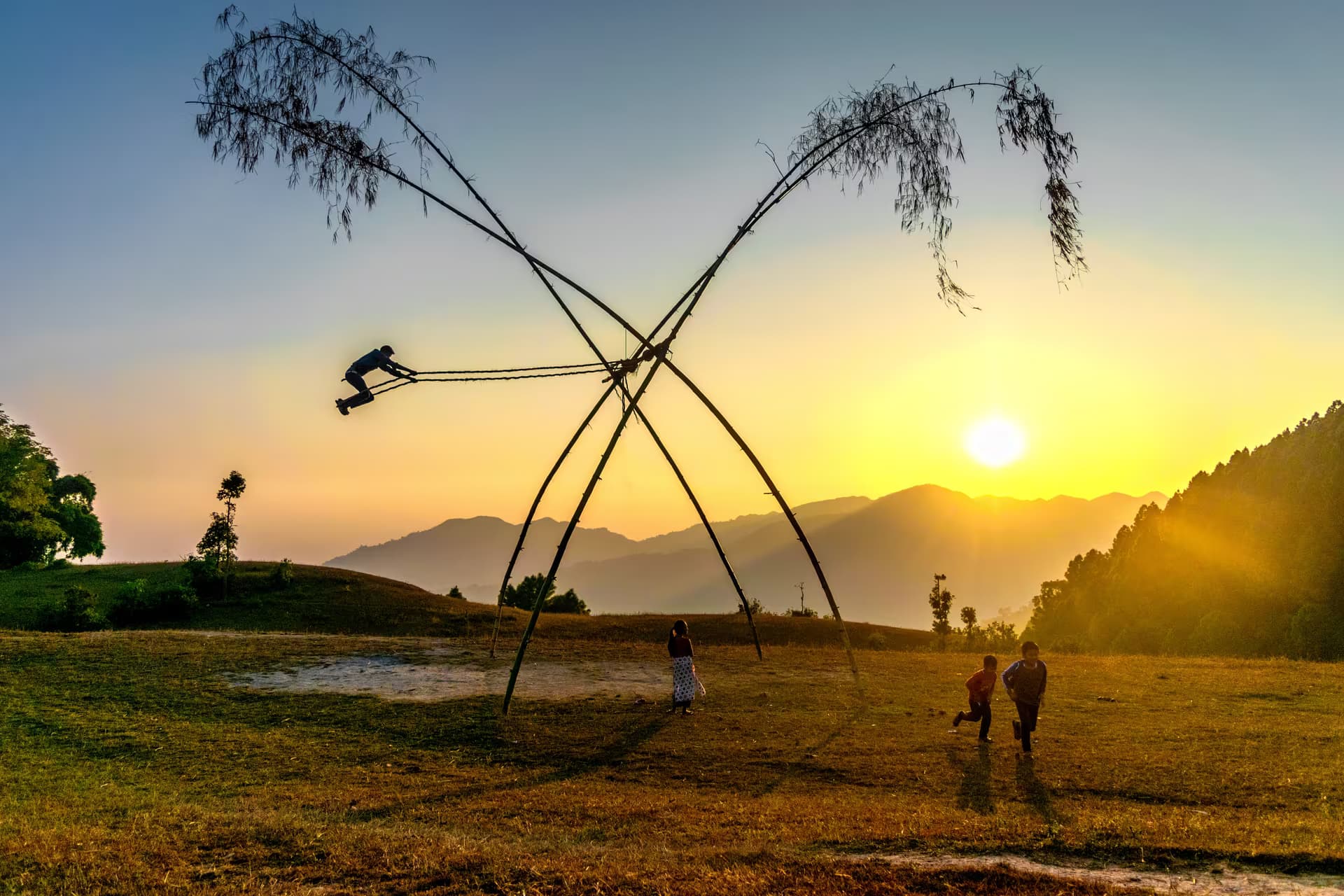
The ping, the bamboo swing, goes up in villages a week before the festival and comes down after Tihar; the custom is older than the Hindu layer of the festival. Houses are cleaned and repainted, new clothes are bought for children — often the only new clothes of the year — and sel roti, the ring of fried rice-flour batter, is made in quantities that last the fortnight. Cards and dice come out and are played, quite openly, in a country where gambling is otherwise illegal.
What is changing
Urban Dashain is getting shorter. A fifteen-day festival is difficult to hold together in a two-income household with a fixed holiday allowance, and for many Kathmandu families the fortnight has compressed into the four or five days around tika. Sacrifice is receding. Kites are receding. Meanwhile a genuinely new form has appeared: diaspora Dashain, in Sydney and Dallas and Doha, where community halls are booked for a Saturday near the tika date and elders who cannot travel give blessings over video calls. Whether that counts as the festival surviving or the festival changing is an argument Nepali families are having among themselves.
After Dashain
Dashain does not end the season. Tihar follows about a fortnight later — five days of lights, crows, dogs, cows and brothers, gentler and more domestic — and in the Newar calendar the two are joined by Mha Puja and the Nepal Sambat new year. Many people who come home for one stay for both.
Guides that feature this place
- Seasonal9 min
Dashain 2026: Dates, the Full 15-Day Schedule, and Tika Day
Dashain 2026 runs October 11-25, with Vijaya Dashami tika on Wednesday, October 21. The fifteen-day schedule day by day, when Fulpati and tika fall, which temples open, and how to travel in Nepal's busiest fortnight.
- Seasonal8 min
Tihar 2026: Dates, All Five Days, and Laxmi Puja Night
Tihar 2026 runs November 7 to 11, with Laxmi Puja on Sunday, November 8. All five days with their dates from the official 2083 BS patro — including why Laxmi Puja falls a day earlier than usual this year — plus Bhai Tika, Mha Puja and Nepal Sambat, and where to see it.
Elsewhere in this region
Help us get it right
Know Dashain (Vijaya Dashami) better than we do?
We write from research and reporting, and the ground changes faster than we can keep up. If something here is out of date, or you have been and would tell it differently, we would rather hear it.