
Monastery · Buddhist
Myanmar Golden Temple (Lokamani Pula Pagoda)
म्यानमार स्वर्ण मन्दिर
Shakyamuni Buddha (Theravada tradition)·Among the earliest post-1978 international monasteries in Lumbini·Rupandehi
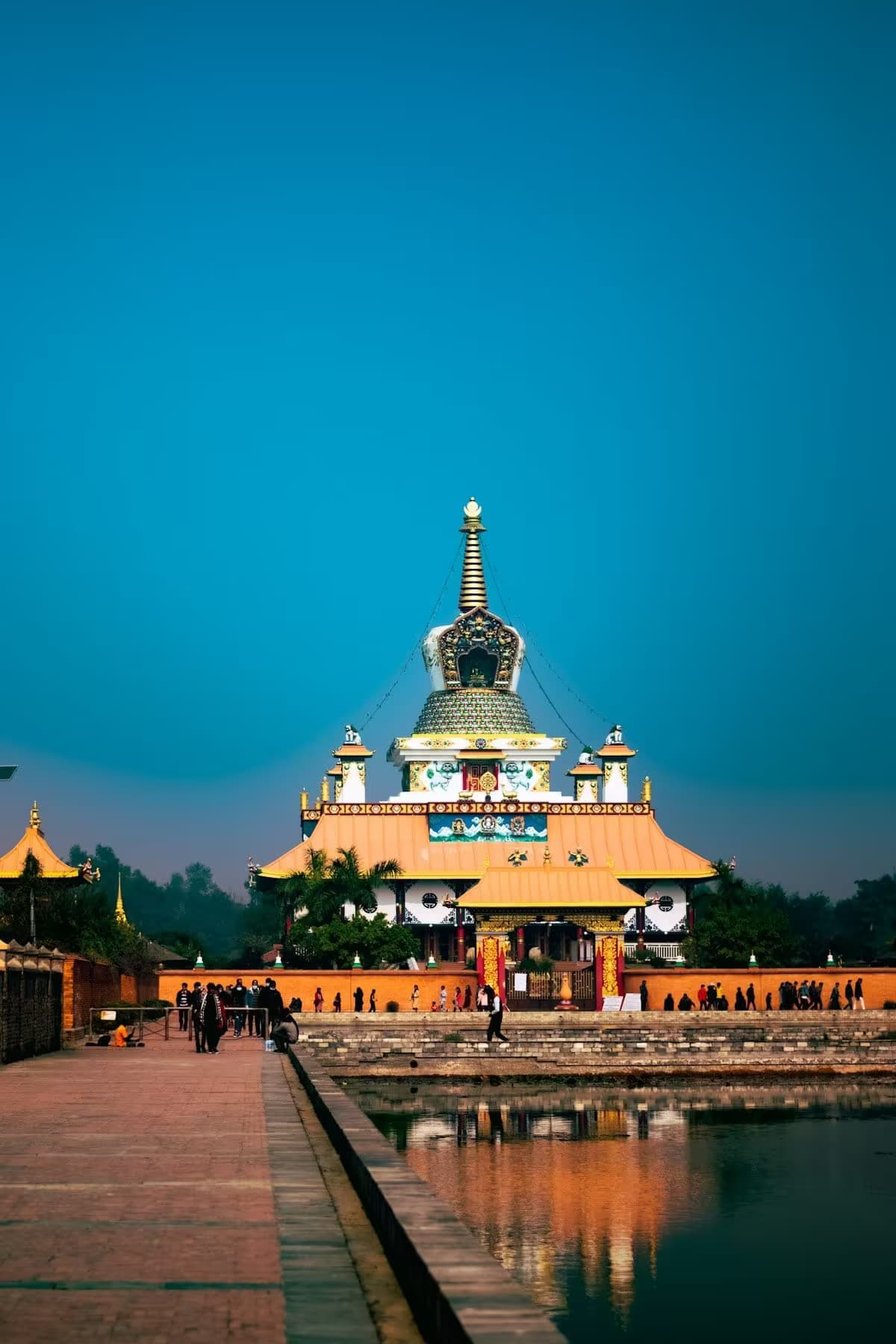
One of the oldest and most striking monasteries in the Lumbini monastic zone — a gilded Burmese-style complex whose tall corn-cob shikhara soars above the eastern canal.
Dedicated to
Shakyamuni Buddha (Theravada tradition)
Period
Among the earliest post-1978 international monasteries in Lumbini
Hours
06:00 – 18:00
Admission
Free
Neighborhood
East Monastic Zone, Lumbini
The Myanmar Golden Temple, formally the Lokamani Pula Pagoda, was one of the first international monasteries built in the Lumbini Development Zone after Kenzo Tange's master plan was adopted in 1978. It sits in the East Monastic Zone (reserved for Theravada traditions) on the eastern side of the central canal and is today one of the most visually striking monuments at the site.
The complex is built in classical Burmese temple style, dominated by a tall, slender golden corn-cob shaped shikhara modelled on the Ananda Temple of Bagan and the Shwedagon Pagoda of Yangon. The exterior is covered in gold leaf and small mirror mosaics that catch the Terai sunlight; the interior is cooler and more restrained, with a large seated Buddha in bhumisparsha mudra (earth-witness pose) as the main image. A secondary white pagoda and a small community hall complete the compound.
Resident monks from Myanmar host visitors daily; simple accommodation for long-stay pilgrims is available in the adjacent dormitory block. The temple is particularly busy during Thingyan (Burmese New Year, April) and Vesak/Buddha Jayanti (May), when the Myanmar community holds public chanting sessions and almsgiving. The monastery is an easy 15-minute walk from the Maya Devi Temple.
Folio III
Nearby Sacred Sites
Places within a short walk that help turn this stop into a small sacred cluster.

Royal Thai Buddhist Monastery, Lumbini
A striking all-white marble monastery in the East Monastic Zone — built by the Royal Thai government in classical Thai temple style, with a soaring multi-tiered roof and golden finials.

Cambodian Monastery, Lumbini
A Khmer-style Theravada monastery in the East Monastic Zone — a compact compound modelled on the great temples of Angkor, with a tiered pyramid tower and characteristic face towers.

Zhong Hua Chinese Buddhist Monastery
A grand Ming-style monastic complex in the West Monastic Zone — one of the largest and most elaborate monasteries in Lumbini, with ornate red-and-gold roofs and imposing gateway pavilions.

Korean Buddhist Temple, Dae Sung Shakya Sa
A large Mahayana monastery in the West Monastic Zone, built by the Korean Jogye Order — one of the biggest monastic compounds in Lumbini, with colourful painted eaves and a giant seated Buddha.

Sri Lankan Monastery, Lumbini
The Sri Lankan Theravada monastery in the East Monastic Zone — a white Sinhalese-style *vihara* with a dagoba-shaped stupa and resident Theravada monks.
Coda
Continue the Pilgrimage
Part of
Lumbini — Birthplace of Buddha
Planning this visit? Local operators publishing trips here can arrange it.
Elsewhere in this region
Help us get it right
Know Myanmar Golden Temple (Lokamani Pula Pagoda) better than we do?
We write from research and reporting, and the ground changes faster than we can keep up. If something here is out of date, or you have been and would tell it differently, we would rather hear it.