Temple · Hindu
Changu Narayan Temple
चाँगुनारायण मन्दिर
Lord Vishnu (Narayan)·4th century CE (earliest known temple in the valley)·Bhaktapur·UNESCO World Heritage
The oldest temple in the Kathmandu Valley, home to Nepal's earliest dated inscription — and traditionally remembered as spared by the 1349 invasion.
Dedicated to
Lord Vishnu (Narayan)
Period
4th century CE (earliest known temple in the valley)
Hours
6:00 AM – 6:00 PM
Admission
Local 300 · USD 3
Neighborhood
Changu Village
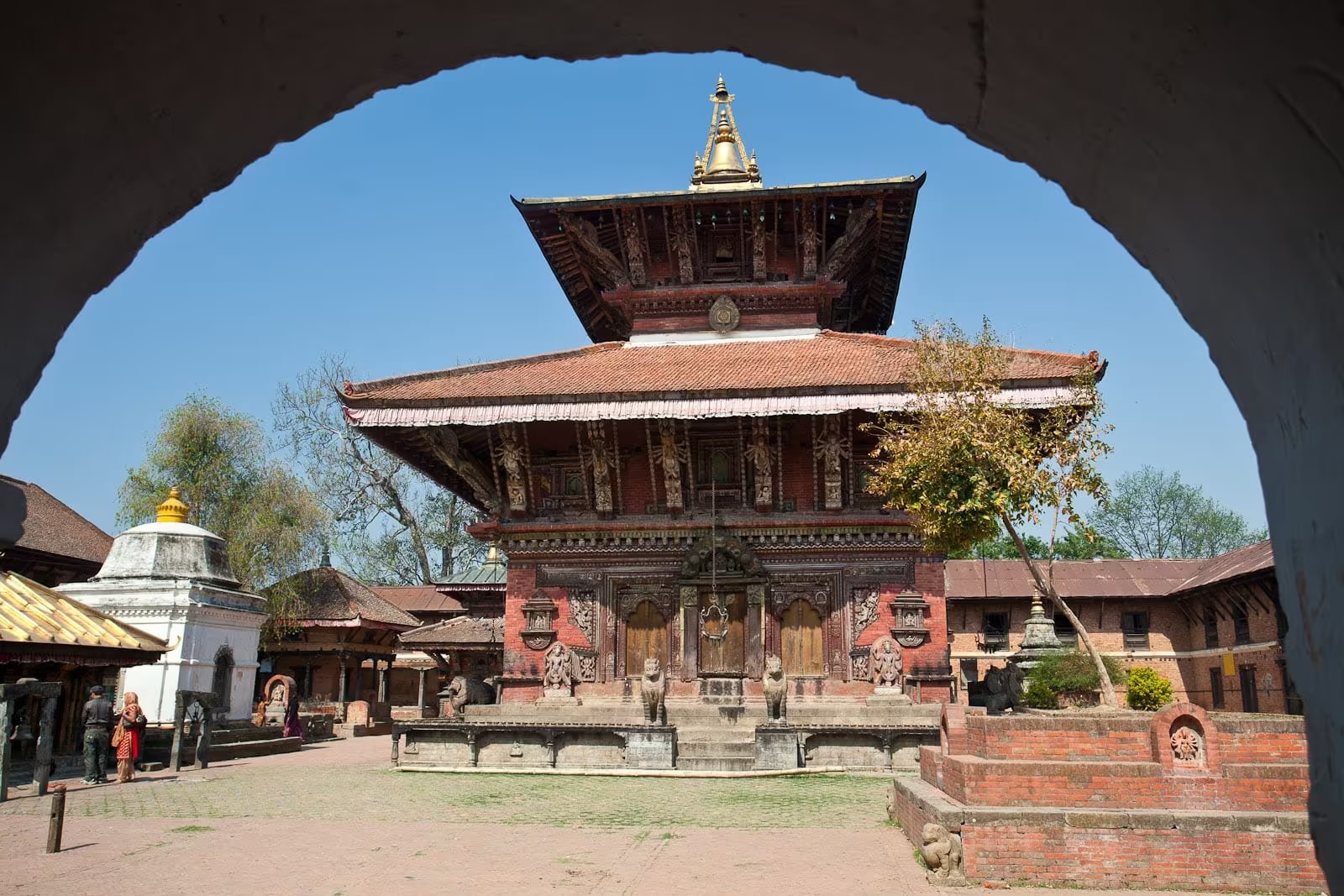
Changu Narayan crowns a forested ridge above the Manohara River east of Kathmandu, and by most measures that matter, this is where Nepal's recorded history begins. Dedicated to Vishnu as Narayan, the temple has been in continuous worship since the Licchavi era — the oldest temple in the Kathmandu Valley, standing in a courtyard so crowded with early masterworks that historians treat it as an open-air museum. It is a UNESCO World Heritage Site, yet it remains first of all a working village shrine, with bells, butter lamps, and a priest on duty every morning.
The pillar where Nepali history begins
In front of the temple stands a stone pillar raised by the Licchavi king Manadeva in 464 CE, bearing the oldest dated inscription ever found in Nepal. It is no dry administrative record but a family drama in polished Gupta-script Sanskrit: when King Dharmadeva died suddenly, his grieving queen Rajyavati prepared to follow him onto the funeral pyre, and the young Manadeva pleaded with his mother until she relented — choosing to live and guide her son's reign instead. The same stone goes on to record Manadeva's campaigns east and west: the first firm ground in fifteen centuries of Nepali history, still standing where it was planted.
The shrine tradition says was spared
When the Bengal sultan Shamsuddin Ilyas Shah raided the Valley in 1349, his army looted Kathmandu for days and damaged major shrines including Swayambhunath and Pashupatinath. Changu Narayan, hidden on its ridge, is traditionally remembered as a great shrine the raiders did not reach. Its luck did not hold forever: fire gutted the building in 1702, and the two-tiered pagoda you see now is the rebuilding by King Bhupalendra Malla and Queen Riddhi Laxmi, crowned with gilt copper roofs a few years later. So the visible temple is Malla-era; the consecrated ground beneath it, the inscriptions, and the sculptures around the courtyard are vastly older. The 2015 earthquake shook the complex hard, and it has been patiently restored since.
A courtyard of Licchavi masterworks
Walk the courtyard slowly: it holds some of the finest stone sculpture in the subcontinent. Vishvarupa shows Vishnu's overwhelming universal form; Narasimha, the man-lion, tears open the demon king; the striding Vikrantha covers the cosmos in three steps. The celebrated image of Vishnu riding Garuda — among the most reproduced artworks in Nepal — is here too, along with a kneeling, human-faced Garuda facing the shrine that tradition places as far back as Manadeva's own era. Around them, the temple itself displays Newar craft at full power: carved roof struts, repoussé toranas, and a gilded west door fit for a king's offering.
Rajopadhyaya priests and Bagmati water
Daily worship belongs to the Rajopadhyayas — the hereditary Brahmin priesthood of the Newars — who alone serve the deity inside the sanctum, supported by Newar lineages with inherited duties of their own: the Bhadel traditionally carry silver kalashes of holy water drawn from the Bagmati near Pashupatinath for the temple's rituals, binding the Valley's oldest Vishnu shrine to its greatest Shiva one. Changu is also the seniormost of the Char Narayan — the Valley's four ancient Narayan shrines, honoured together by pilgrims with Ichangu Narayan, Bisankhu Narayan, and Shesh Narayan at Pharping.
Visiting
The classic approach is the ridge walk down from Nagarkot — a half-day descent through pine forest and millet terraces that ends at the temple's back gate. From Bhaktapur Durbar Square it is a short drive or a pleasant cycle. The brick-paved street of Changu village below the temple is lined with thangka painters' studios and farmhouses, and a small museum keeps coins, tools, and manuscripts from the village's long memory. For more of the tradition, browse the Hindu temples collection.
Best visited in autumn.autumn: best, 8°C to 25°C. Clear valley and mountain views. Perfect conditions for the hike and exploring Nepal's oldest Hindu temple. monsoon: possible, 19°C to 28°C. Trail from Nagarkot can be muddy. The temple's ancient stone carvings are atmospheric in the mist. spring: good, 10°C to 28°C. Pleasant hilltop temperatures. Great for combining with the Nagarkot-Changu Narayan hike through terraced farmland. winter: good, 2°C to 18°C. Cool and quiet. Excellent visibility of the Kathmandu Valley below. The ancient carvings are best photographed in low winter sun.
The Almanac
Trail from Nagarkot can be muddy. The temple's ancient stone carvings are atmospheric in the mist.
Coda
Continue the Pilgrimage
Guides that feature this place
Trips that visit here
Elsewhere in this region

Help us get it right
Know Changu Narayan Temple better than we do?
We write from research and reporting, and the ground changes faster than we can keep up. If something here is out of date, or you have been and would tell it differently, we would rather hear it.