Teej (Haritalika Teej)
तीज
Also known as: Hartalika Teej, Haritalika Teej, Teej Festival
Nepal's women's festival — three days of fasting, feasting, dancing in red saris, and praying for marital bliss at Pashupatinath.
Location
Nationwide (especially Pashupatinath Temple)
Duration
3 days
Month (Local)
Bhadra
Month (AD)
August/September
Highlights
Kilometre-long queues of women in red saris at Pashupatinath from before dawn. Dar Khane Din — a whole night of rich food, singing and dancing, on the eve of the fast. The nirjala fast: twenty-four hours without food or water, observed at full strength by many. New Teej songs released every Bhadra and played from every shopfront — increasingly about women's rights, not only Parvati. Red saris, glass bangles, pote and fresh henna, everywhere, on the same morning. Rishi Panchami's datiwan purification closing the cycle. Shiva and Bhagwati temples in every town running their own smaller, more walkable version.
Tips for Visitors
Pashupatinath before six in the morning or not at all — by nine the approach roads are solid, and the temple interior is closed to non-Hindus anyway (the day happens outside it). For a version you can actually move through, go to any local Shiva or Bhagwati temple instead. Dar gatherings are private; the public signal is the run-up, with halls hosting them nightly for a week or two beforehand. Get the date right — it moves with the lunar calendar and the dar night falls the evening before day one. Don't eat or drink in a temple queue, and don't press food on a fasting friend more than once. Photograph the crowd freely, faces only after asking. Red or bright colours if you are invited to a dar; never black. It falls at the tail of monsoon, so bring rain gear.
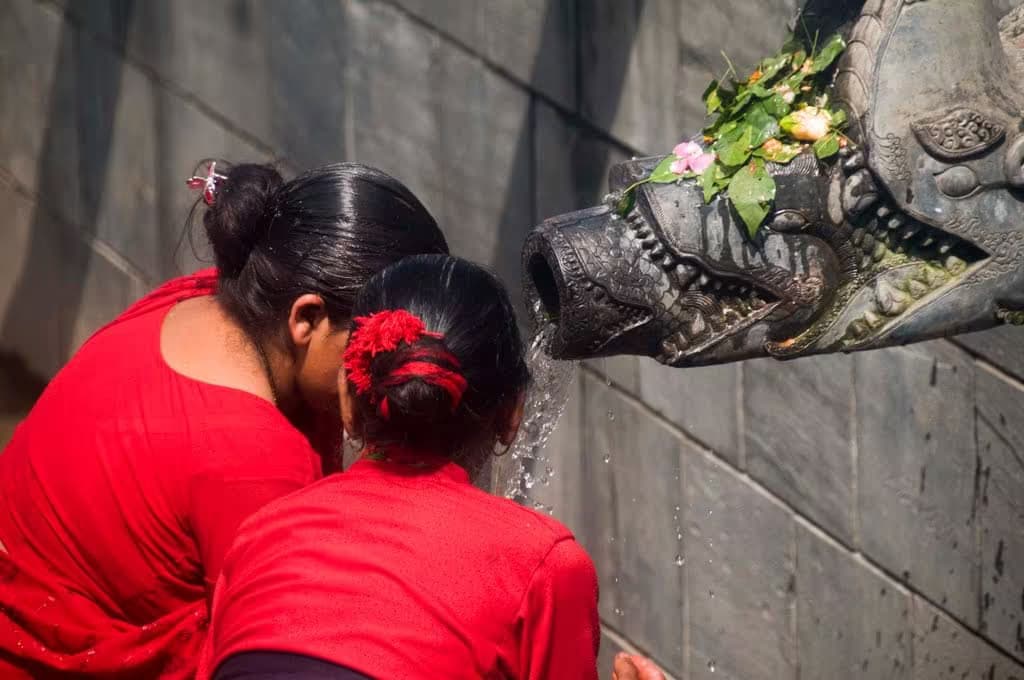
Teej is Nepal's largest women's festival, and for one day in late summer it is the most visible thing happening in the country. Women fast — most of them without a mouthful of water from one dawn to the next — dress in red, and go to a Shiva temple in numbers no other day of the year produces. At Pashupatinath the queue starts forming in the dark, and by mid-morning it runs for kilometres along the Bagmati: a continuous line of red saris, singing, moving a few metres an hour.
The full name is Haritalika Teej, and it comes from the story the fast re-enacts. Parvati, promised by her father to Vishnu, fled to the forest with her closest friend — harit, taken away, and alika, the female friend — and performed austerities there until Shiva accepted her. Married women fast for their husbands' long life; unmarried women fast for a husband like Shiva. That is the stated purpose and it is what most women will tell you. What Teej has also become, over the last generation or so, is the one day when women's collective presence in public is impossible to overlook — and the songs written for it are now among the most direct public speech about women's lives that Nepal produces. Both readings are live at the same time, in the same red sari.
When it falls
Teej is the third day of the waxing moon in Bhadra — Bhadra Shukla Tritiya — which lands in late August or September. In 2026 the three days run Monday 14 to Wednesday 16 September, with the dar feast on the evening before, Sunday 13 September. The dates panel above is the authority: this moves with the lunar calendar, and two consecutive years can sit three weeks apart.
The three days are not equal. The first, Tritiya, is Teej proper and carries the fast. The third, Panchami, is Rishi Panchami, the purification that formally closes the cycle. The middle day is quiet. And the day that most people actually attend — Dar Khane Din — falls outside the count altogether, on the eve.
The night before — dar
Dar is a heavy meal eaten to carry you through a fast, and Dar Khane Din is a whole night built around it. Women gather in groups — sisters and sisters-in-law, neighbourhood circles, office colleagues, a school class thirty years on — and eat deliberately rich food: fried bread, meat curries, kheer, sweets, milk. Then they sing and dance, often until well past midnight, in red saris taken out of storage and whatever gold the household owns.
It is women's space. Men are marginal to it at best, and in most gatherings entirely absent. In villages the courtyard is the venue; in Kathmandu it is a party palace or a rented hall, booked months ahead.
The fast
The nirjala fast — nir, without; jala, water — is the festival's centre and its hardest part. The strict form takes nothing at all, not even water, for roughly twenty-four hours, and many women observe it in full while going to work and running a household through the day. Modified fasts are ordinary and carry no stigma: fruit only, or water allowed, for the elderly, the unwell, the pregnant, and increasingly for anyone who simply decides so. Some husbands fast alongside their wives. Some women have stopped fasting and go for the dar and the songs.
If you are a visitor with fasting friends or colleagues, the useful thing to know is that they will not eat or drink in front of you or away from you, and that offering repeatedly is a small kindness that lands as pressure. Ask once, then leave it.
Where to see it
Pashupatinath is the centre, and on Teej morning it is the single most crowded place in Nepal. Non-Hindus cannot enter the main temple but the whole point is outside it anyway — the eastern bank, the ghats, the hillside, the queue. Go before six or don't go; by nine the approach roads are solid.
Beyond it, every Shiva temple and most Bhagwati temples in the country have their own version at a scale you can actually walk through — often a better experience than Pashupatinath if you want to see the day rather than the crowd. In the Kathmandu Valley the temples around the three durbar squares fill up; in any hill town, ask for the Shiva temple and go early.
Dar gatherings are the harder thing to see, because they are private by nature. What is public is the run-up: from a week or two out, halls and restaurants across the cities are hosting them nightly, and groups of women in red walking home late in the evening are the signal that the season has started.
Red, gold and henna
Red is the colour of saubhagya, marital auspiciousness, and the colour Parvati wore through her penance. The sari is usually the wedding sari or something close to it, worn with glass bangles, pote — the strung glass-bead necklace — sindur, and henna applied a day or two before. The visual is the festival's most reproduced image for a reason: tens of thousands of women in the same colour on the same morning, in one temple complex.
If you are invited to a dar and want to dress for it, red or any bright colour is right and black is not. Nobody expects a foreign guest in a sari, and nobody minds one either.
The songs
Teej songs are two traditions at once. The older repertoire is call-and-response, unwritten, carried in memory and sung in circles — Parvati's story, married life, sisterhood, the hard parts said out loud in a setting where they are allowed to be said.
The other is a commercial industry with a release calendar. New Teej tracks drop through Bhadra, get played from every shopfront and bus, and are ranked and argued over; folk singers build careers on one good Teej song a year. The lyrics have followed the audience: alongside the devotional and the playful, a substantial share now deal with domestic violence, property rights, migration and marriage on women's own terms. The festival's cultural licence covers speech that is harder to make elsewhere, which is most of why the songs matter.
Rishi Panchami
The cycle closes on Rishi Panchami, two days after the fast: a purification bath, teeth cleaned with datiwan twigs, prayers to the Saptarishi, the seven sages. Traditionally the rite addresses ritual impurity accumulated through menstruation over the year. A great many women who perform it now read it instead as a restoration after the body's discipline, and both readings coexist without anyone needing to settle the argument. Practically, it is the day the red sari goes back in the cupboard.
The extravagance argument
Teej gets criticised in Nepal every year, and it is worth knowing the argument exists rather than being surprised by it. The dar season has stretched from one night to several weeks, moved into party palaces, and acquired a cost — venue, gold, a new sari — that falls on households that cannot always carry it. Set against that: the objection to women spending money and taking up public space arrives with a suspicious frequency, and the same commentary rarely troubles Dashain. It is a genuine argument with a genuine counter-argument, and most Nepali women have a settled position on it. You do not need one.
A note for visitors
Teej is not a spectacle staged for anyone. It is a fast, and much of what you are watching is people being physically uncomfortable in public for reasons that matter to them. Photograph the crowd and the colour freely; ask before photographing a face, and accept a no. Don't eat or drink in a temple queue. If you are offered prasad after the fast breaks, take it.
Nepal's other big festivals arrive shortly after — Krishna Janmashtami falls about ten days before, Indra Jatra a week or two after, and Dashain inside a month — so Teej is a good anchor for a September trip built around the festival calendar.


Guides that feature this place
- Seasonal8 min
Teej 2026: Dates, the Three Days, and the Dar Night Before
Teej 2026 runs September 14-16, with the nirjala fast and the Pashupatinath queues on Monday, September 14 and the dar feast the evening before, Sunday, September 13. The day-by-day schedule, where to watch, what women wear, and visitor etiquette.
- Seasonal7 min
Best Time for a Nepal Pilgrimage: Festivals, Weather & Crowds
A pilgrimage-focused seasonal guide to Nepal covering weather, crowds, festival timing, high-altitude access, Terai heat, and when to visit major sacred sites.
Elsewhere in this region
Help us get it right
Know Teej (Haritalika Teej) better than we do?
We write from research and reporting, and the ground changes faster than we can keep up. If something here is out of date, or you have been and would tell it differently, we would rather hear it.