The Cow Procession
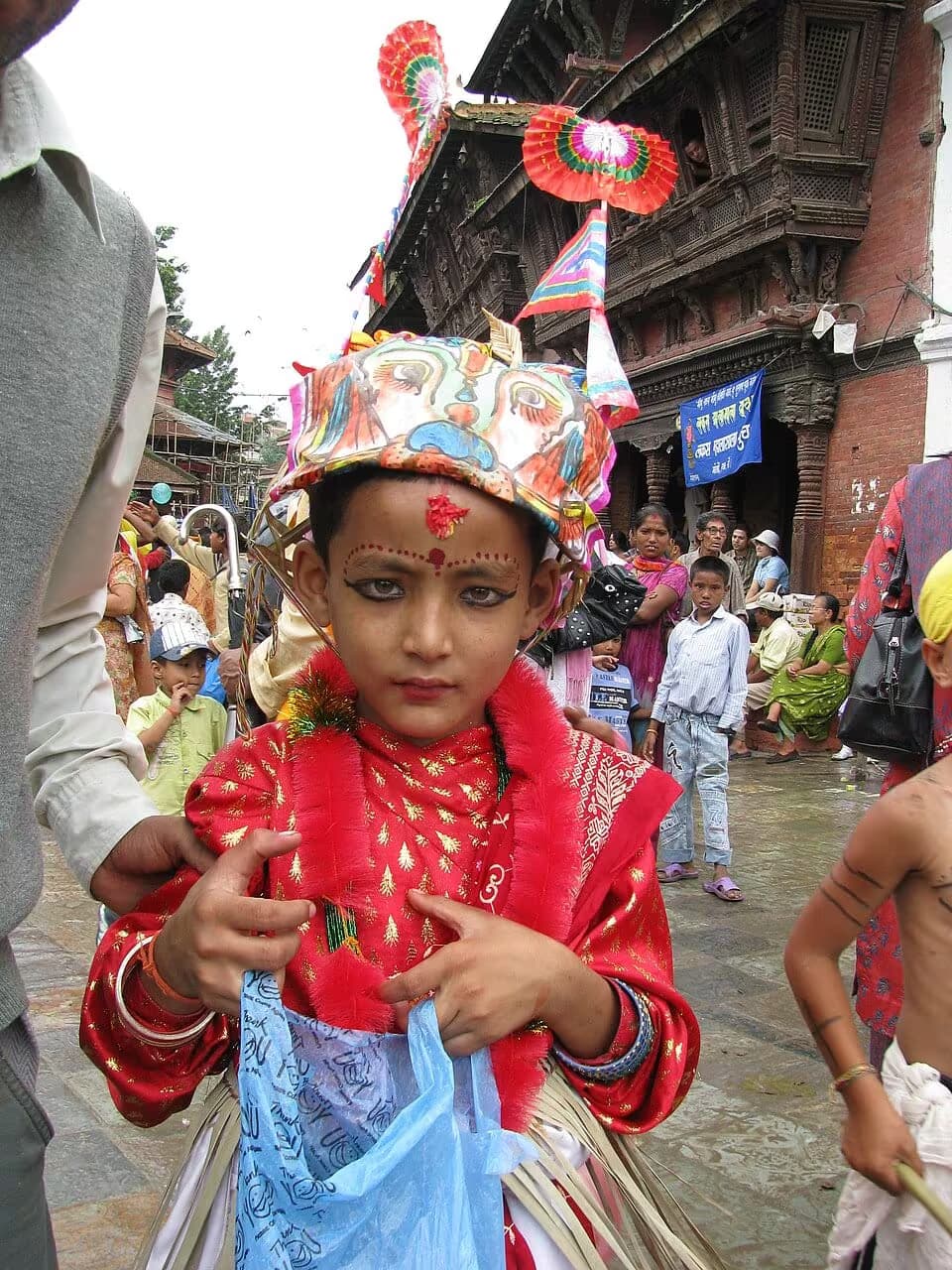
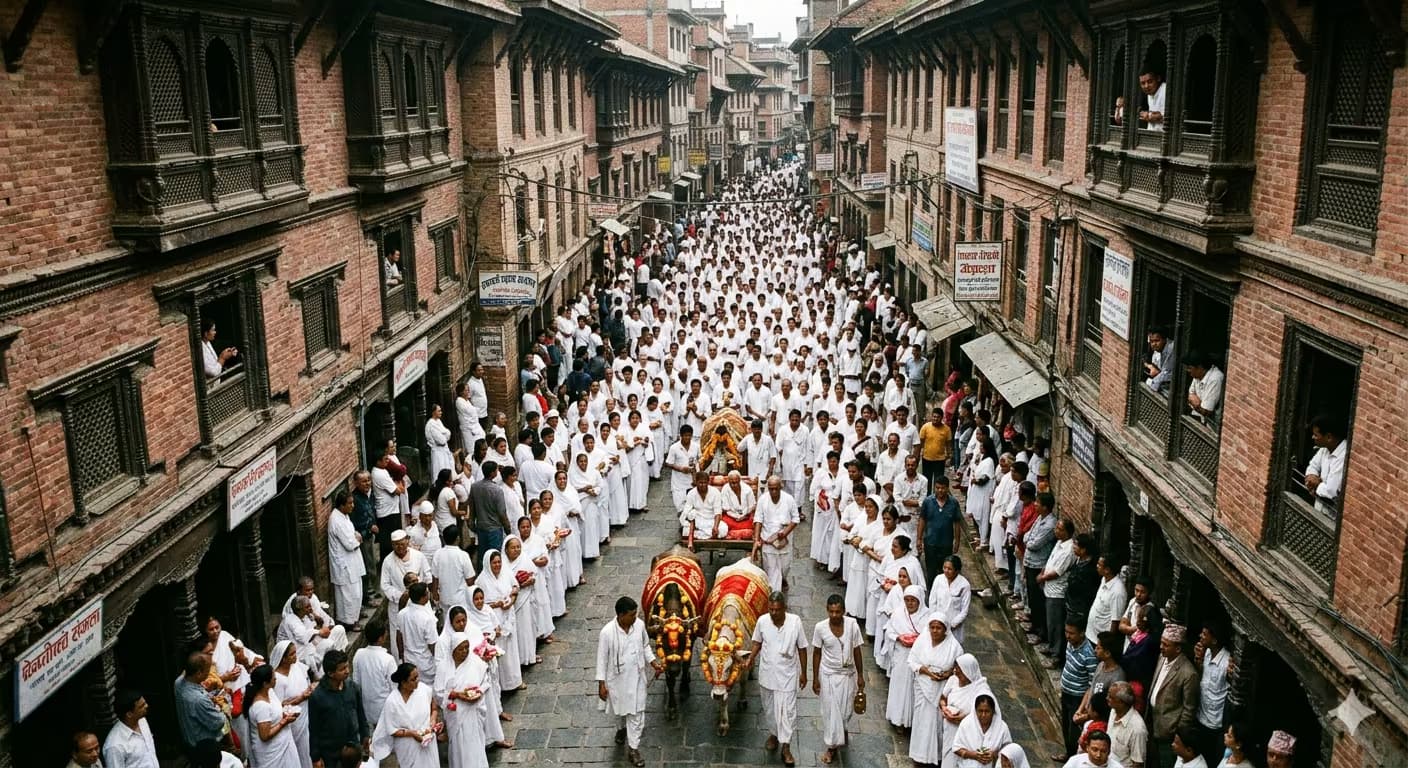
On the morning of Gai Jatra, participating bereaved families in the Kathmandu Valley who have lost a member in the past year lead a decorated cow through the streets — or a young boy painted as a cow — in a solemn procession believed to guide the departed soul safely to the afterlife.
The Cow as Psychopomp
In Hindu cosmology, the cow (gai) is the vehicle that carries the soul across the Vaitarani River — the boundary between the world of the living and the realm of Yama, god of death. A family that sends a cow in procession on Gai Jatra is providing their departed member with passage across this threshold. The belief is specific and practical: without this ritual aid, the soul's journey is more difficult. The cow is not a symbol of grief or of life — it is functional equipment for the afterlife, and the procession is the act of sending it.
The Morning of the Procession
Families in white mourning clothes emerge from their homes at dawn, leading decorated cows through the old city streets. The cows are adorned with garlands, tika, and cloth coverings. Where a real cow cannot be obtained or managed in dense urban streets, a young boy — often a son of the bereaved family — is dressed in cow costume: a bamboo frame draped in white cloth with a painted cow face. The substitution is ritually valid; the boy becomes the cow for the duration of the procession. Both forms — real cow and costumed child — move through the streets with the same ritual purpose.
The Route
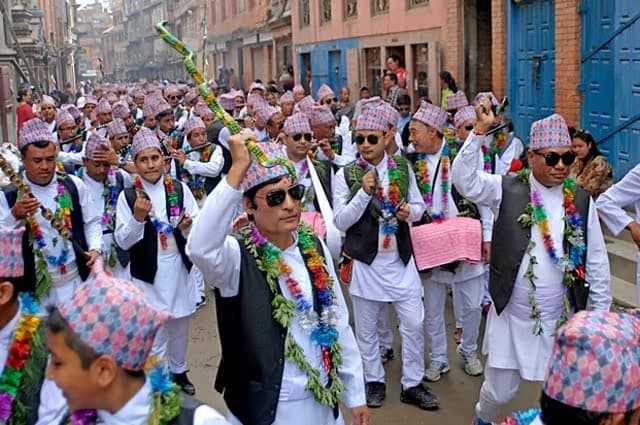
Processions converge on the durbar squares: Kathmandu's Hanuman Dhoka, Patan's Mangal Bazaar, Bhaktapur's Durbar Square. Each neighborhood has its traditional route; the main arteries of the old cities fill with cows, cow-costumed boys, and families walking in measured grief. The accompaniment is Newar music — dhimay drums and dhaa cymbals — but the dominant register is quiet. This is a mourning procession, not a celebration. The music marks the passage without overwhelming the solemnity.
The Grief Made Public
Gai Jatra does something unusual: it makes private grief publicly visible. In a society where death is ritually contained and mourning has prescribed periods, this is the one day when grief walks through the street at the pace of a cow, seen by the entire community. Families who have lost someone see other families who have lost someone — each cow and each costumed boy represents a specific person, often named. The procession is simultaneously personal and collective: the community's losses are tallied visibly together, each loss acknowledged, none minimized, all carried through the city in the same morning light.
Valley-Wide Variation
Kathmandu's procession is the largest, but Patan and Bhaktapur have their own, and smaller Newar towns — Kirtipur, Thimi, Bungamati — observe the tradition in their own streets. The variations in costume, music, and route are local expressions of the same core ritual. What remains constant across all of them — cow-as-psychopomp, family-in-mourning, the procession through the neighborhood that knew them — is the ritual's logic, unchanged across centuries.
The Guthi System
The Gai Jatra procession is made possible by the Newar guthi system — hereditary civic and religious associations that have organized neighborhood life in the Kathmandu Valley for centuries. Each tole's guthi bears responsibility for specific aspects of the festival: coordinating the mourning families, maintaining the procession route, funding the dhimay drummers, and preserving the ritual's correct form year after year. Visitors who understand guthi understand why Gai Jatra is so precisely organized across dozens of neighborhoods simultaneously — it is not a spontaneous gathering but the expression of an institutional infrastructure older than most governments. The guthi system makes Gai Jatra a living demonstration of Newar civil society, where the obligation to organize the cow procession is inherited across generations.
Related
Connected places and entries worth pairing
Janai Purnima
Sa Paru falls the day after Janai Purnima
Matya
Patan's Matya follows on the next day

Krishna Janmashtami
Bhaktapur's stick dancing runs from Sa Paru until Janmashtami, seven days later

Bhaktapur Durbar Square
Bhaktapur keeps the festival with taha macha effigies along the main street
Gathamuga: Charhe
The season Sa Paru belongs to is opened by the burning of Ghantakarna
Characters
Rituals & Ceremonies
Procession Routes
Part of Gai Jatra